
Calgary has more history than you think!
While Calgary is a young city (established as a town in 1884), it has an impressive number of historical buildings and sites. Even 50 years ago it was a small city whose population was only 300,000 people. However, over the past 50 years the city’s growth has exploded.
Today, it boasts a population of 1,600,000 people making it the fourth largest city in Canada. It is home to two historic main streets, five history museums as well as dozens of heritage buildings and 100s of century homes. Calgary is a hidden gem for history buffs.
In this article I will highlight some of Calgary’s best heritage buildings, parks, gardens and one of Canada’s largest living history museums. Let’s begin…
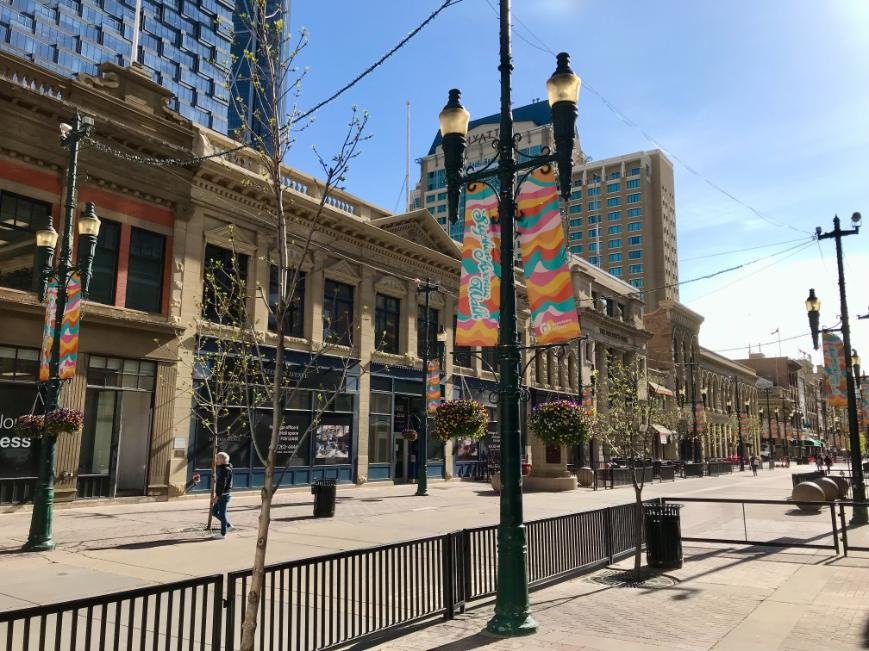
Calgary’s Stephen Avenue pedestrian mall in the downtown is lined with early 20th century buildings, that is a designated National Historic District.
Biggest & Best
Heritage Hall (1301 16th Ave NW), located on the campus of the Southern Alberta Institute of Technology (SAIT) completed in 1922, it is notable for its Collegiate Gothic style and is still the focal point of the campus. It features twin towers with parapets, gothic arches, an auditorium with a minstrel gallery, terrazzo flooring and gargoyle stone workings.
Inside, its staircases are home to several vintage murals created by teachers and students in the middle of the 20th century when it included an art college. Link: https://everydaytourist.ca/calgary-visitor-information/calgary-hidden-gems-saits-vintage-murals
Today, it is surrounded by ultra-modern buildings, which enhances the timelessness of this brick jewel. You could easily spend a couple of hours wandering the campus looking at the integration of the old and new architecture.
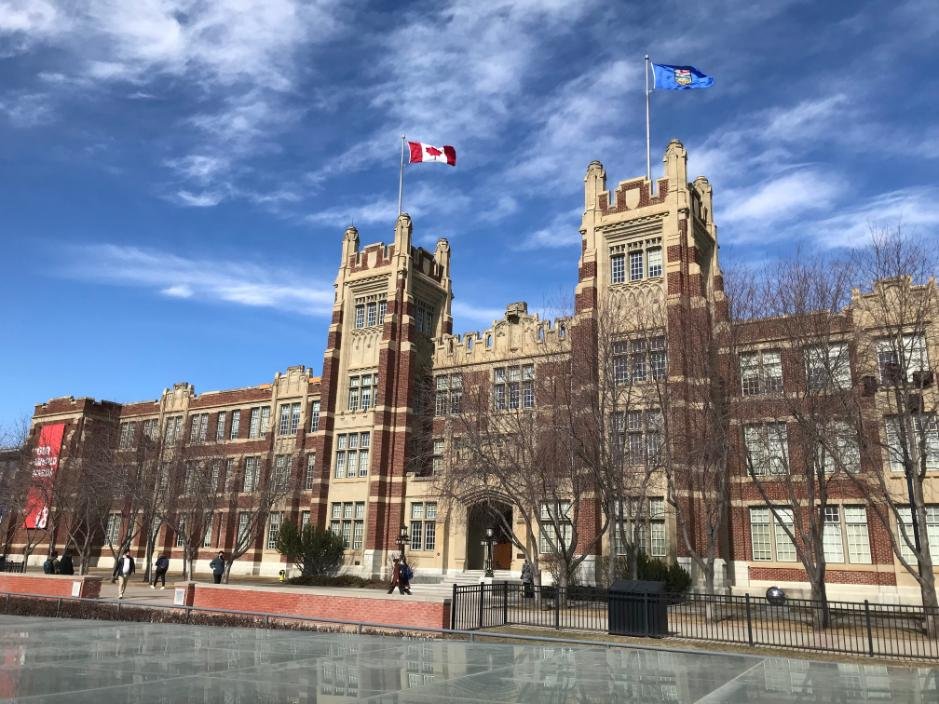
Heritage Hall is one of Calgary’s architectural gems.
Located just below the SAIT campus is Riley Park and Senator Patrick Burns Memorial Rock Garden (corner of 5th Ave and 10th Street NW). Riley Park was once part of the huge 146,000 hectare Cochrane Ranch. In 1888, Thomas and Geogina Riley and their family of 10 children homesteaded the land that is the park today. Then, in 1909 following Thomas’ death their homestead land was left to the city. Today, it is home to a cricket pitch dating back to 1919, a wading pool, a perennial flower garden, bandstand, large playground and huge lawn that is used for all kinds of passive activities.
There is also a small Senator Patrick Burns Rock Garden (named after one of the founders of the Calgary Stampede) was constructed in the 1950s, utilizing 20,000+ pieces of flagstone from the senator’s demolished mansion.
If you are really into gardens, wander over to the Sunnyside LRT station and grab the train. Get off at the Erlton Station and walk 5 minutes to the Reader Rock Garden (325 25th Ave SE). It is one of Calgary's most unique cultural landscapes featuring the restored Reader House (now a café) rock pathways, bridges, benches and beautiful flowers. It is the perfect spot for lunch or an afternoon coffee and treat.
Hot Tip: If you are into cemeteries, you can wander to the nearby Union, Burnsland Cemeteries, Chinese, Jewish and St. Mary’s cemeteries all clustered just south of the Reader Rock Garden.
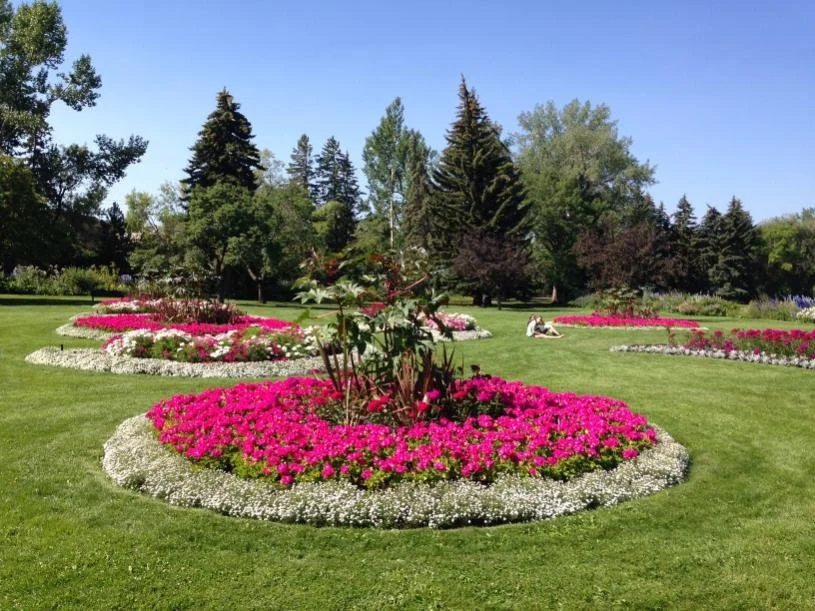
Riley Park is home to a flower garden, cricket pitch and large wading pool.
City Centre Heritage Fun
Located at the west end of downtown sits the 1918 castle-like Mewata Armoury. Its historic significance derives from its association with the federal government’s efforts to provide training facilities for Canada's armed forces after 1900. Since the end of the WWII, the armoury has been in constant use as home for Militia and Communications Reserve, and as Headquarters for Southern Alberta Militia District as well as for several Cadet Corps.
This Tudor-Gothic building is notable for its huge central ogee-arched troop door flanked by protecting three-storey crenelated towers. Inside, steel trusses support the roof over a massive drill hall. There is also a M4A2(76)W Sherman Tank (used by the King’s own Calgary Regiment during WWII) standing outside the armoury.
FYI: Mewata is a Cree word for ‘O Be Joyful’ or ‘to be happy.’
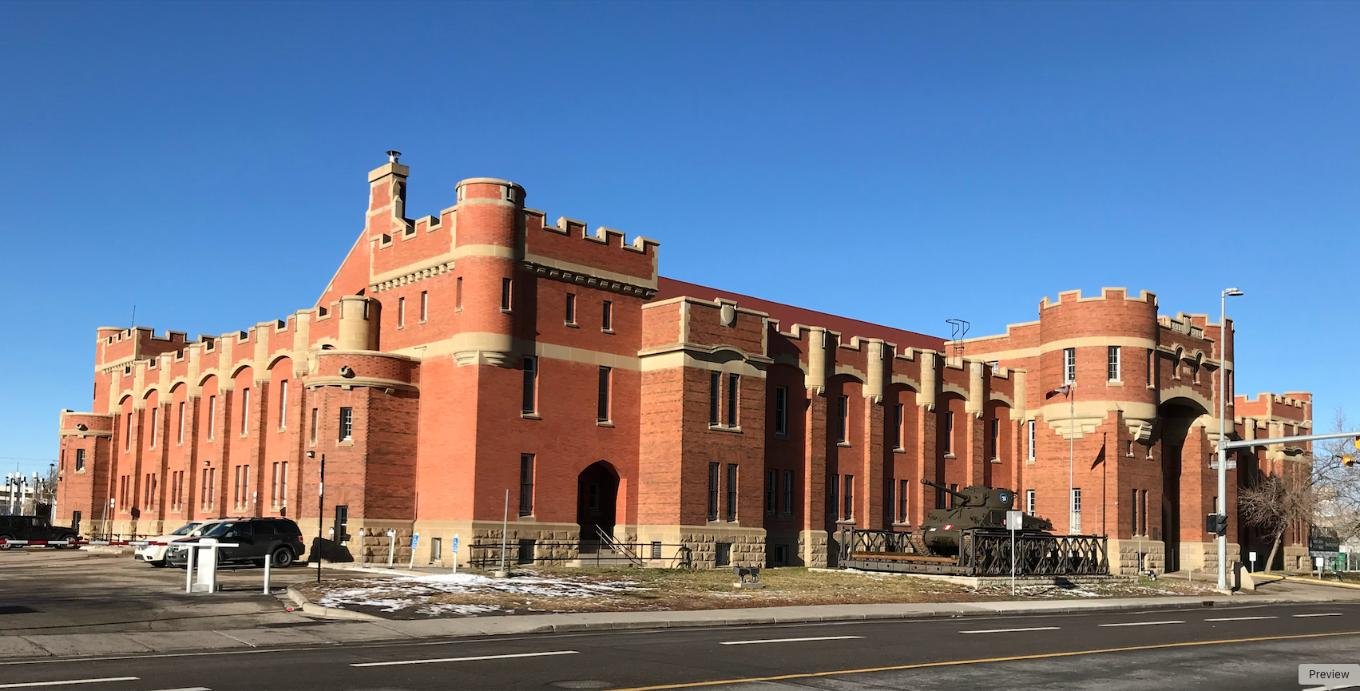
Mewata Armoury is another of Calgary’s heritage gems.
Next to the Mewata is one of the Calgary’s best examples of brutalist architecture, originally Calgary’s Centennial Planetarium, it is now Contemporary Calgary, a public art gallery. This concrete building, which opened in 1967 to celebrate Canada’s Centennial year combines a roof dome with flat angular planes that foreshadow the architecture of one of today’s most famous architects Frank Gehry. It was designed by the local architectural firm of McMillan and Long and Associates and was recognized for its unique Brutalist design with the Massey Medal in Architecture in 1970.
Calgary’s heritage Hudson Bay Company Department Store (7th Ave and 1st St SW) is just 10 short blocks away - you can walk or hop on the LRT Free Fare zone along 7th Ave and get off at the 1st Street SW station. This is Calgary’s fourth Hudson’s Bay Company store. This building was originally just half the size of what you see today. Originally, it had 40 departments, a circulating library and a “rendezvous” salon where patrons could sit and read, write letters or meet up with friends. It even had a rooftop playground where a “governess” would look after the children while parents shopped.
Its beloved colonnade was part of the 1930 addition that doubled the size and created a new main entrance off Stephen Avenue. In 1985, a third expansion extended the building further west along Stephen Avenue. Both extensions, duplicated the terra cotta façade of the original building giving it a unique sense of place amongst the mostly sandstone buildings along Stephen Avenue.
Sadly, today it sits empty as the Hudson Bay Company recently declared bankruptcy. Fortunately, the building’s exterior can be enjoyed from the street and there is still a restaurant with a lovely patio on Stephen Avenue under the colonnade.
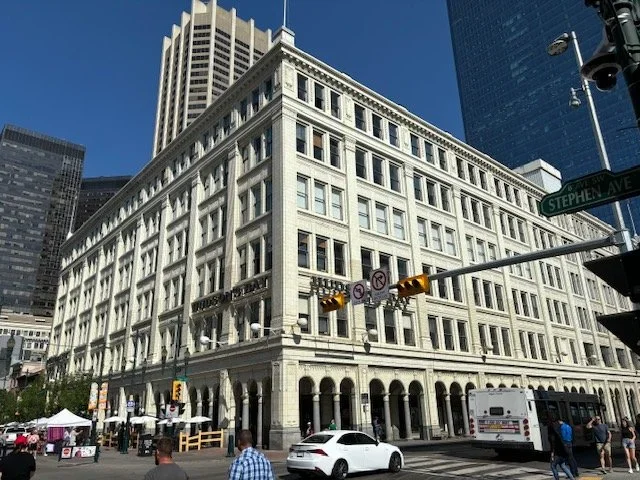
The cream glazed teracotta facade of the Hudson’s Bay building anchors the Stephen Avenue heritage district.
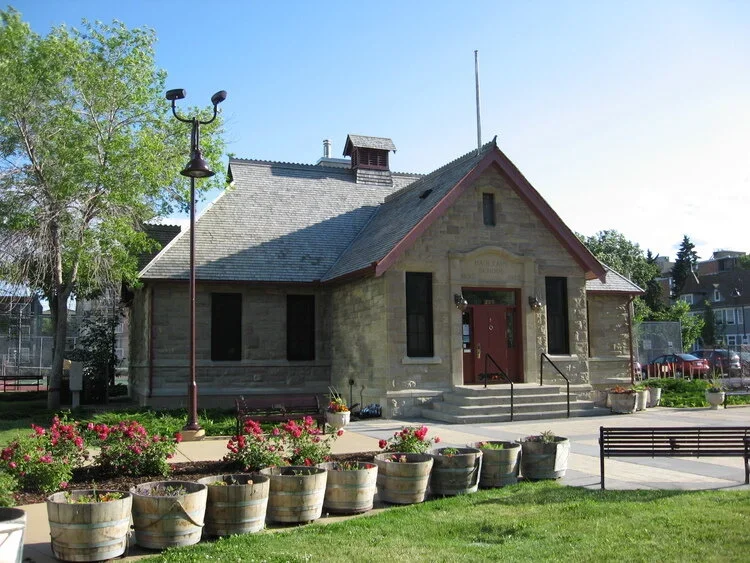
The Haultain School is home to the Calgary Parks Foundation today.
If you walk south along 1st Street SW, past the historic Grain Exchange Building and Palliser Hotel (See Calgary: The Sandstone City), then under the railway tracks to 13th Ave and turn right, you will come to small building at 2nd St SW - the Haultain School.
Dating back to 1894; it was Calgary’s first sandstone school and the oldest surviving school. Designed in the Richardsonian Romanesque style, it features a unique hand-hewed, rough-faced sandstone façade, round arched windows, and a distinctive hip roof topped by a wooden bell tower.
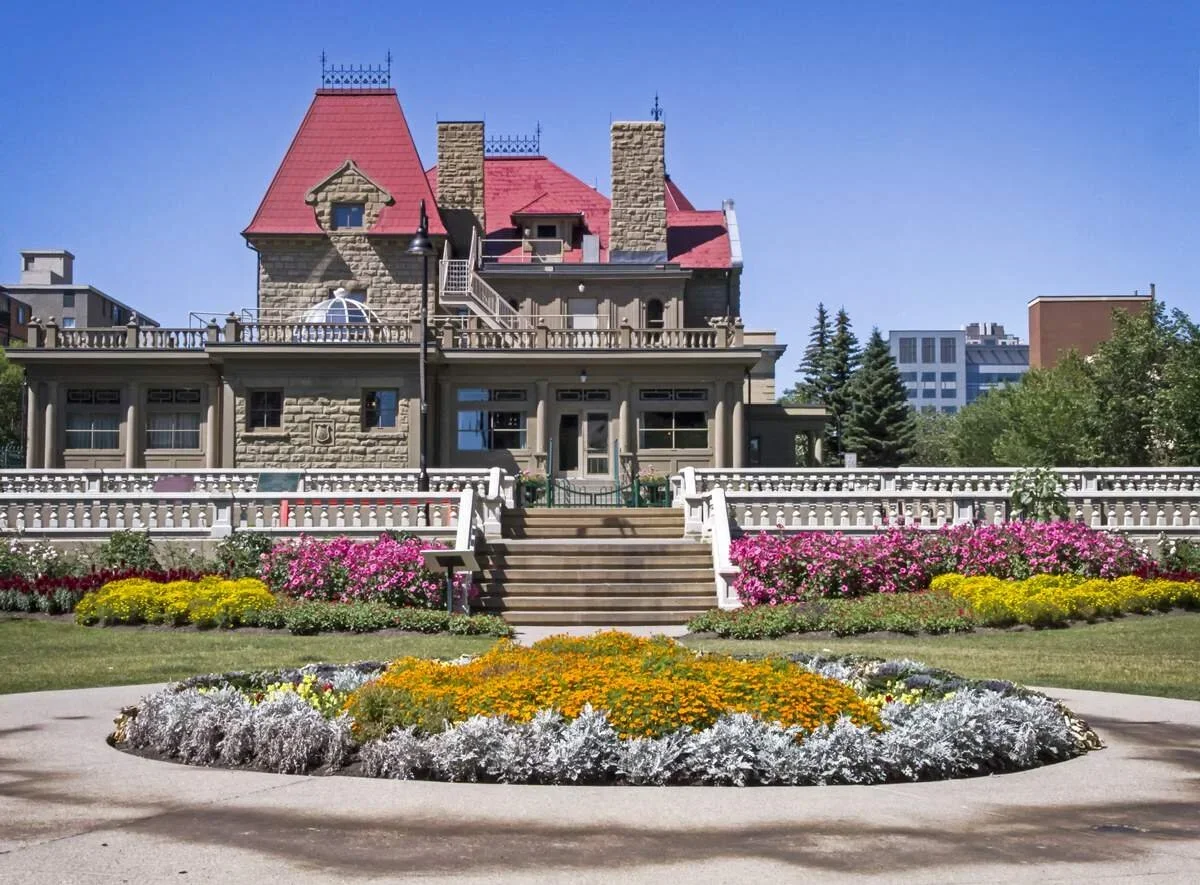
The Lougheed House and gardens is an oasis in the middle of the Beltline neighbourhood, a high-rise urban village south of the downtown core.
Just across the street is the majestic Central Memorial Library (see Calgary: Sandstone City article) that anchors Memorial Park. The park has an interesting history: the land was set aside for a park in 1889. It was initially used as tree nursery, but by 1912, it was an “unsightly wilderness” when Chief Librarian Alexander Calhoun identified it as the best site for Calgary’s first library. With the assistance of a Carnegie Foundation grant, Alberta’s first library was built with the entire block devoted to becoming a park with a cenotaph and statues honoring the soldiers who died in the two World Wars and other warfare.
The most recent remodelling of the park (completed in 2008) added fountains, washrooms and a cafe. Parks Canada recognizes the park as a historic site for its formally designed landscape which includes a strictly symmetrical layout with elaborately designed beds, paths, lawns, specimen planting, two decorative water fountains and numerous monuments and memorials. The 2-storey library is surrounded majestic 100+ year old spruce trees.
FYI: Be sure to check out the historic story boards along 13th Avenue SW between 2nd and 4th Street SW. (Note there is no 3rd St SW in this part town, a fun Calgary quirk).
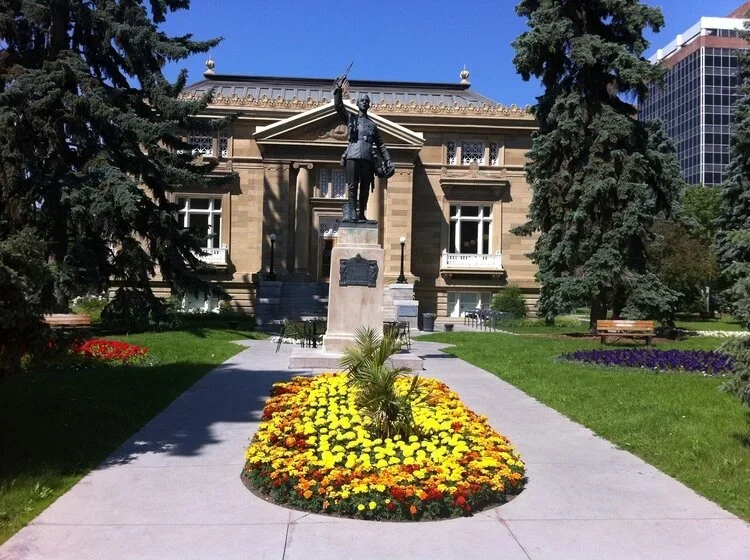
Memorial Park Library sits at the eastern edge of the Memorial Park. This Carnegie Library was Alberta’s first library and the main floor is still a library today.
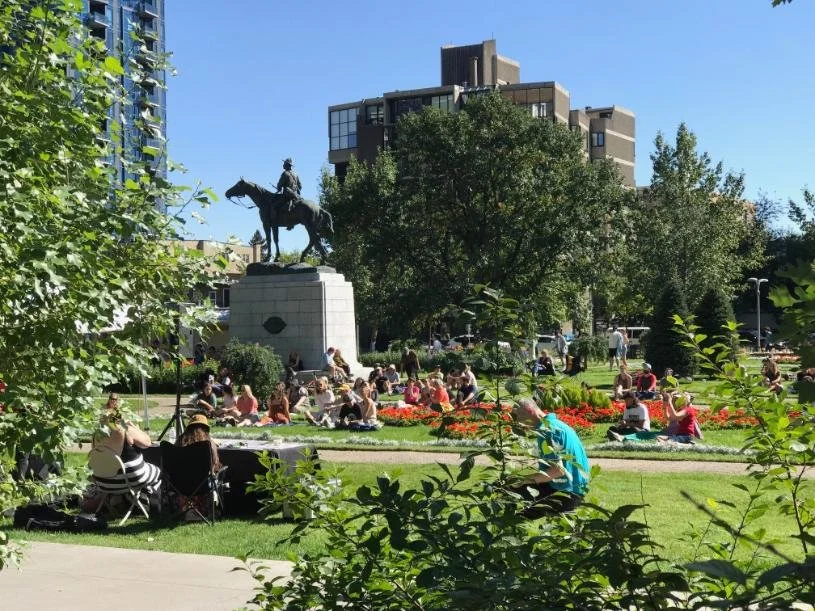
Central Memorial Park is one of the city’s oldest parks.
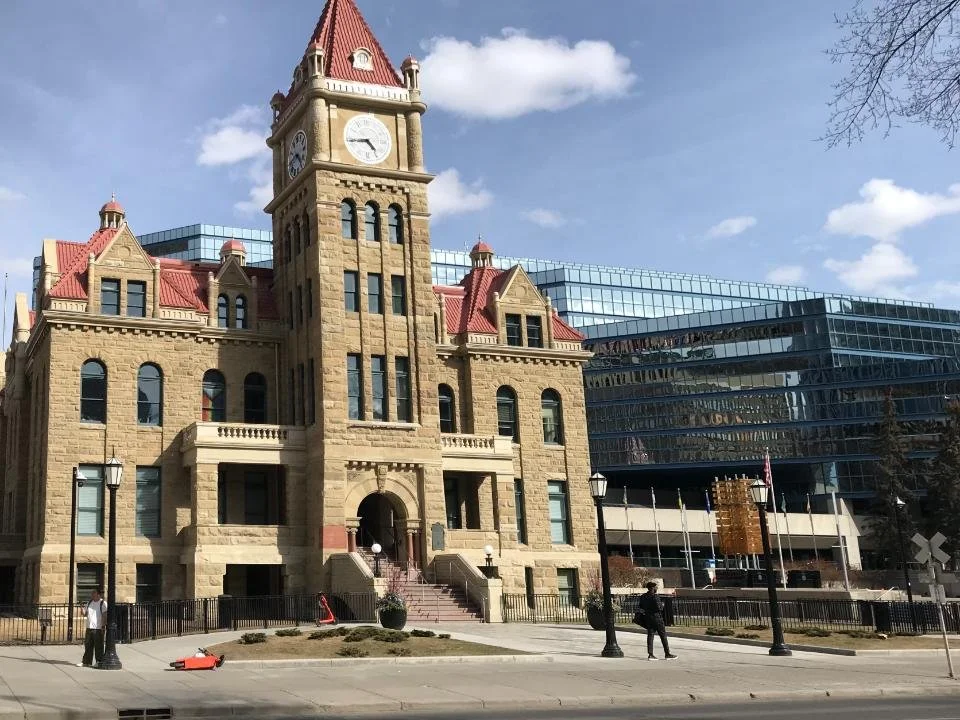
Old City Hall is just one of Calgary’s many heritage sandstone buildings, hence the nickname “The Sandstone City.”
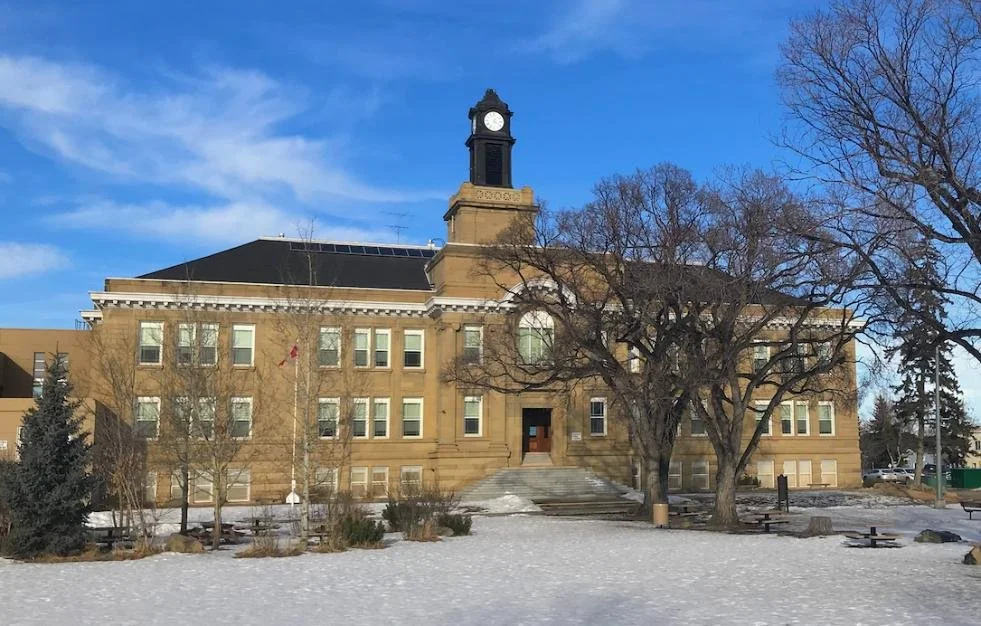
Calgary is home to several large sandstone school that still function as schools 100+ years later.
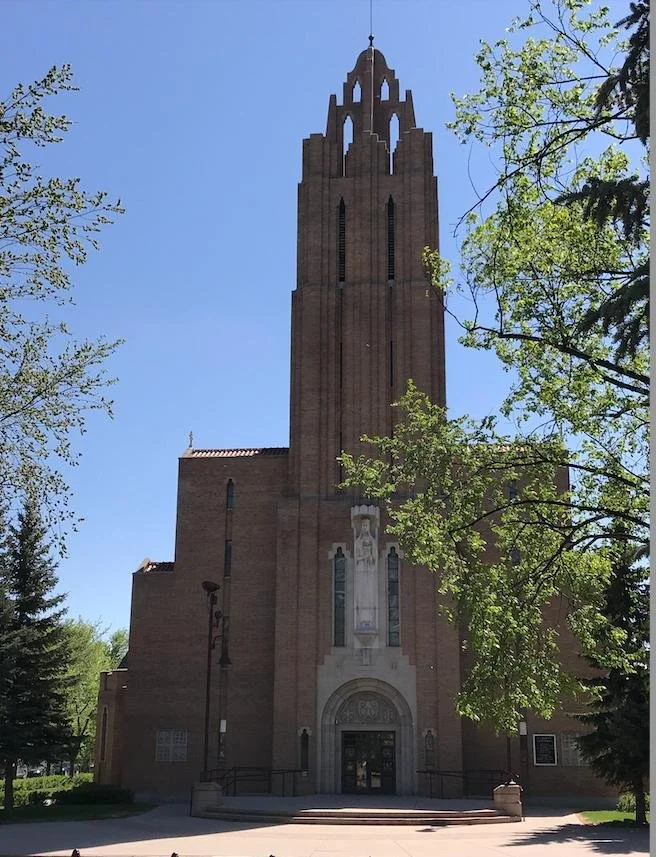
St.Mary’s Cathedral anchors Calgary’s Mission neighbourhood.
Calgary History Museums
Heritage Park
Located on the edge of Glenmore Reservoir is the 137-acre Heritage Park, one of Canada’s largest living history museums.
Note: A living history museum immerses visitors in a specific historical period by recreating authentic environments with historical buildings, tools, and artifacts, often using costumed interpreters to demonstrate past skills, tell stories, and simulate daily life through first-hand experiences.
Here you will find dozens of early 20th century buildings collected from Calgary and small towns from across Alberta to recreate an early prairie town – church, fire station, grain elevator, police station, bakery, school, post office, homes etc. There is even a small farm and carnival areas.
When you arrive, you take a historic Calgary streetcar from the parking lot to the main entrance. You can also take heritage paddle steamer ride on the S.S. Moyie around the reservoir. If you are a train fanatic, you will want to spend time in the Roadhouse, a new building that is full of heritage train cars and locomotives. If vintage cars are your thing, then the Gasoline Alley is a “must visit” with its amazing collection of antique cars, trucks and vintage gas related artifacts.
Heritage Park offers something for the entire family.
Address: 1900 Heritage Drive SW (the Park is only open from May long weekend to Canadian Thanksgiving (second Monday in October). However, Gasoline Alley is open year-round.
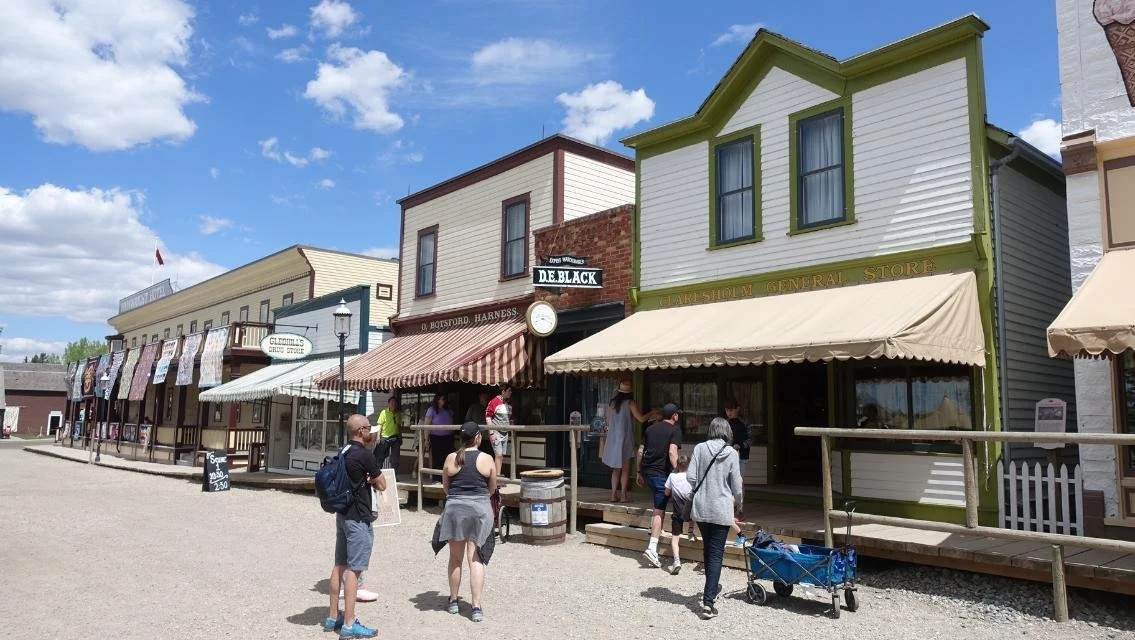
Heritage Park is Canada’s largest living history museum.
National Music Centre
Calgary is home to Canada’s National Music Centre (aka Studio Bell - the Bell corporation bought naming rights for 12 years) which incorporates the storied blues bar in the King Eddy Hotel, within a five storey, uber-contemporary building. Inside, you will not only find exhibitions showcasing Canadian music but the Canada’s Music, Country Music, Songwriter and Quebec’s ADISQ. The museum’s collection of over 2,000 rare instruments spans 450 years of music history. Some of the highlights are an Elton John piano, the Rolling Stones mobile recording studio and TONTO the first (and largest) multitimbral polyphonic analog synthesizer.
Address: 850 4th Street SE
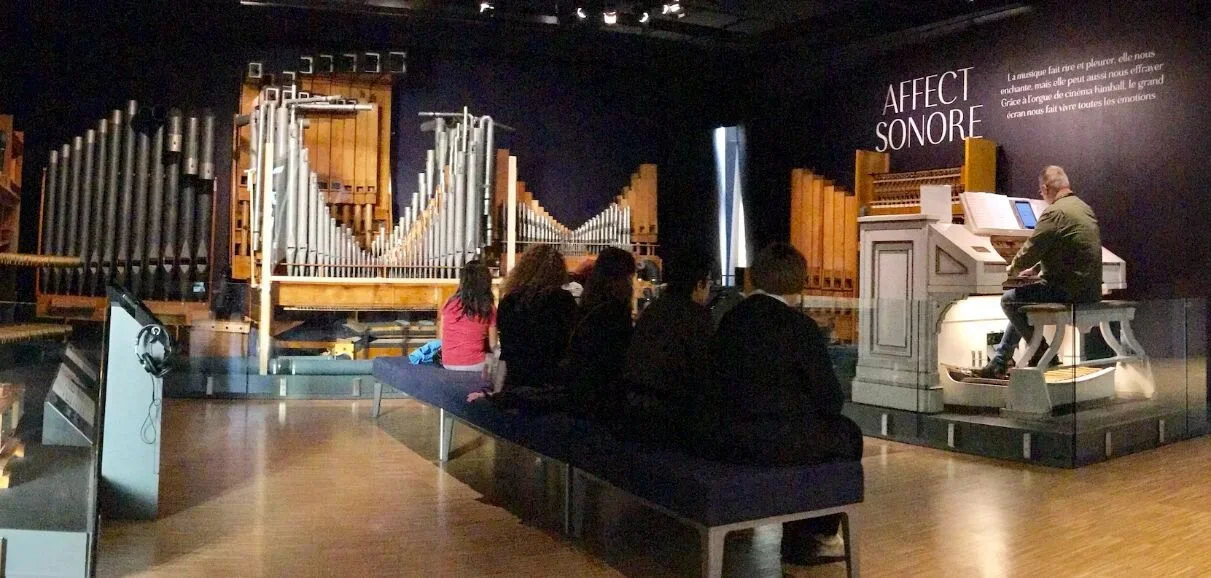
The Kimbell organ is just one of the many highlights of the National Music Centre.
Glenbow / JR Shaw Centre for Arts & Culture
In 1955, Glenbow Museum’s founder, Eric Harvie, created the Glenbow Foundation to pursue his passion for collecting items (artworks, natural history specimens, photographs, documents and cultural artifacts) that represented the history and culture of Western Canada.
The Glenbow is both a history museum and an art gallery. It is scheduled to reopen in late 2026.
In April 1966, the Glenbow Alberta Institute Act was proclaimed, with Harvie donating his collection of art and objects to the people of Alberta, along with a $5 million endowment to create and sustain Glenbow Museum, which was matched by the Alberta government.
A brutalist building was designed in the early 1970s to house the museum and bring its extensive collections all under one roof. It was part of a major urban renewal project that included the Calgary Tower, a hotel, convention center, office towers and retail.
The eight-floor museum is currently undergoing a mega makeover that will create 44 exhibition spaces, a roof-top sculpture garden. With its modern pillow-like façade, it will be rebranded the J.R. Shaw Centre for Arts & Culture in recognition of the Shaw Family’s $30 million donation with the condition that the museum’s admission be free in perpetuity.
The museum’s collection includes 100,000 artifacts, including an extensive collection of Military, Mounted Police, Native North American artifacts and 33,000 artworks. The library, which is housed at the University of Calgary, includes 2 million photographs, 100,000 books and 15,000 maps.
The museum will reopen in late 2026 as the largest museum in Western Canada.
Address: 130 9th Ave SE
The Hangar Flight Museum
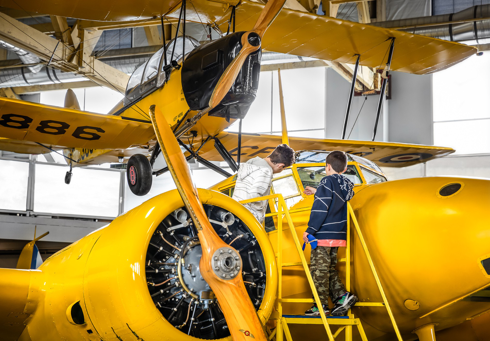
The Hangar Flight Museum is fun for all ages.
The Hangar Flight Museum’s opened in 1975, at the south end of the Calgary International Airport. It is located in the old British Commonwealth Air Training Plan Drill Hall from the Second World War. The collection includes 36 historic military and civilian aircraft (Aeronca Champion, Avro 652 Anson, Avero CF-100, and a rare Avro Lancaster MK X) plus 30,000 aviation artifacts.
The most recent acquisition is the Noorduyn Norseman bush plane that hung from the ceiling of the artium of the downtown Suncor Energy Centre for 40 years. Bush planes were instrumental in the exploration for oil and gas in Canada’s north.
Address: 4629 McCall Way NE.
The Military Museums of Calgary
Located in an old public school, in Garrison Woods (a new residential community created when the Canada Forces Base closed) is the second largest military museum in Canada. It opened in1990, bringing together several collections from the Museum of the Regiments, Naval Museum of Alberta (strange given the province is land locked), Air Force Wing and Calgary Military Museum Society. Is located on the old Canadian Armed Forces Base - Currie Barracks.
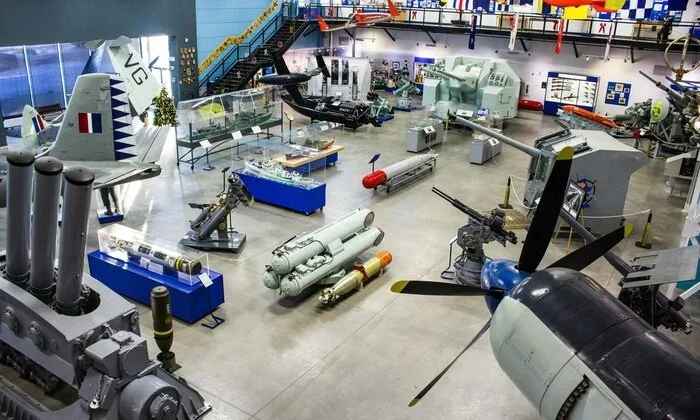
Calgary’s Military Museums is Canada’s second largest war museum.
Each of its four galleries is dedicated to a Calgary area regiment – Lord Strathcona’s Horse Regiment Museum and Archives, Princess Patricia’s Canadian Light Infantry, The King’s Own Calgary Regiment and Calgary Highlanders. Outside sit numerous decommissioned military equipment including a M4 Sherman tank and jeep, as well as Canadair CF-5 plane mounted by its tailpipes in a steep climb. Inside are a Canadair Sabre and a McDonnell Douglas CF-18 Hornet.
Note: Outside is also a twisted piece of steel from The World Trade Centre gifted to Calgary by the United States in recognition of Calgarians who volunteered to assist with the aftermath of the 9/11 terrorist attack in the United States.
Address: 4520 Crowchild Trail SW
Fort Calgary
While the original Fort Calgary from 1875 no longer exists, there is a replica of the 1888 North-West Mounted Police (NWMP) barracks. It is located on 9th Avenue at the confluence of the Elbow and Bow Rivers. Inside is an interpretive centre that tells the history of both the First Nations peoples, the early settlers and the role of the NWMP.
Address: 750 9 Ave SE
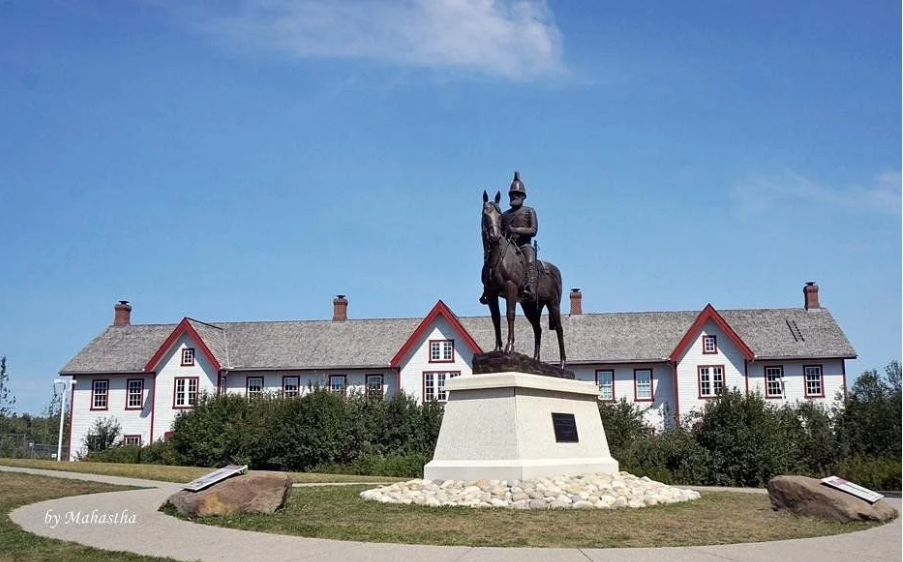
The original fort is gone, but the interpretive centre is modelled after the original barracks and there is a public art work that pays respect to the where the original walls were.
Inglewood Historic Neighbourhood
On the east side of the Elbow River is Calgary’s original downtown and main street. The red brick heritage buildings along its 9th Avenue main street (originally called Atlantic Avenue) are full of eclectic shops, galleries, cafes and restaurants. Take some time to wander the side streets where you will find several heritage churches and century old homes.
If you are a foodie, you will want to check out Rouge, one of Canada’s best restaurants located in the 1891 heritage A.E. Cross House (1240 8th Ave SE). Or you could dine in the 1906 Deane House (806 9th Ave SE), an American Foursquare style building that was originally located at Fort Calgary and home to Richard Burton Deane, NWMP commanding officer from 1906 to 1930. The home was moved in 1914 when Fort Calgary became site of the Grand Trunk Pacific Railway yards. It was moved again in 1929 to its present site.
Next to the Deane House is the 1875 Hunt House, a Metis house originally located at the Calgary Brewing and Malting Company grounds further along 9th Avenue at the eastern end of Inglewood. William J. Hunt, a Royal Canadian Air Force engineer bought the house in 1947 and bequeathed it to the city. It currently is used for storage for the Deane House and is surrounded by a lovely garden.
Or you could choose to dine at National Hotel (925 11th St. SE) that dates to 1907. From 1910 to 1966, it was a “tied house” a term that refers to breweries buying hotels so they could sell their products exclusively. A.E. Cross (a Canadian politician, rancher, brewer and one of the Big Four who financed the first Calgary Stampede in 1912) owned both the hotel and the above-mentioned Calgary Brewing and Malting Company which unfortunately is now closed. Today, it is home to Calgary Chef Micheal Noble’s The Nash restaurant and Off Cut Bar.
Address: 9th Avenue, from 10th Street to 14th Street SE
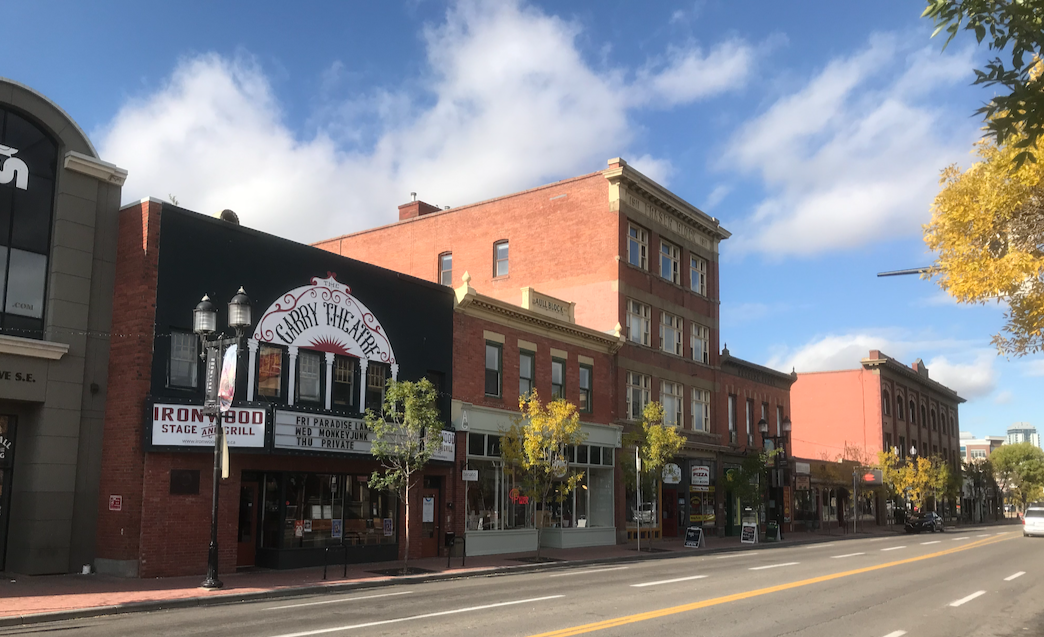
Inglewood’s 9th Avenue was Calgary’s first Main Street. Today it is a vibrant pedestrian street with a mix of shops, cafes, restaurants and galleries.
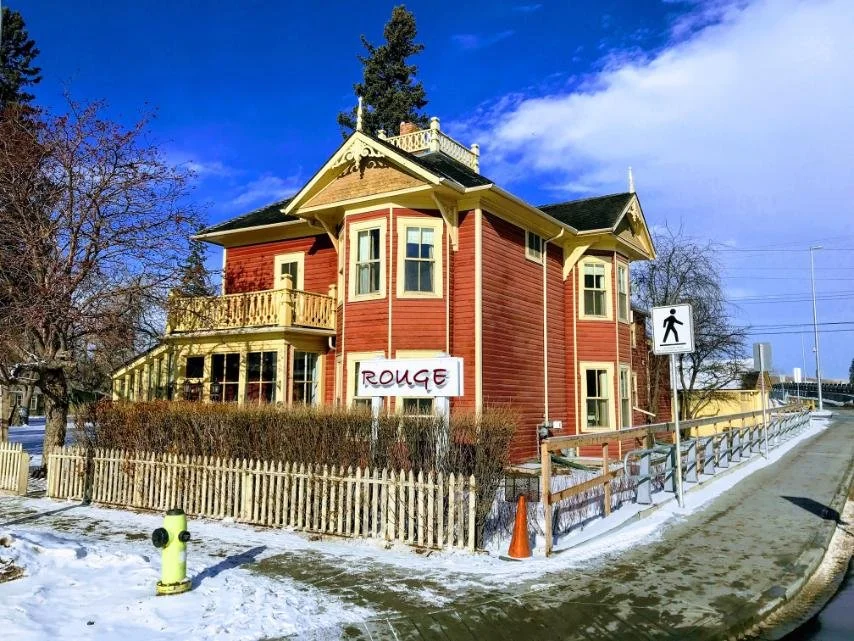
A.E. Cross house is now a restaurant. It is just one of many heritage homes in the Inglewood neighbourhood.
Last Word
This is only the “tip of the iceberg” when it comes to exploring Calgary’s heritage buildings and sites. Wander the Sunnyside and Ramsay communities and you will experience dozens of small, charming early 20th century cottage homes, mixed in with new infill homes. Wander the upscale communities of Mount Royal and Scarboro and be amazed by the ‘city beautiful” tree-lined streets and diversity of architecturally charming heritage mansions.
FYI: The designer of Scarboro was the gifted and dedicated landscape architect, John Charles Olmsted (1850-1920) of the famous Olmsted Brothers firm of Brookline, Mass., which was founded by his adoptive father Frederick Law Olmsted, designer of Mount Royal Park in Montreal and co-designer of Central Park in New York City. Scarboro’s design was commissioned by Canadian Pacific Railway (CPR) to give Calgary the same stature as other well-appreciated cities in North America.
As I said in the title, Calgary has more history than you think!
