
It is a well-known strategy for developers to try and grab as much density as they can get when applying for rezoning a site they want to build on. The developer knows they may not get all the density asked for, but this gives them the ability to reduce the density if/when the community complains the proposed density is too much and still get more density than the site should probably have. This strategy always puts the community in a defensive position, forcing them to lobby against the development and being labelled “NIMBYs.”
For example, the developer can remove 10% of the density they originally asked for and say to the City they have listened to the community, while still be getting 50%+ more than the site was originally zoned for. Or, they will say “Don’t worry; this is the maximum density, but the market will ultimately decide how much density we can build.”
The issue is the fact the developer gets a very specific density up front without having to commit to what they are going to actually build – and what amenities they will ultimately provide the community to compensate them for the additional density. This is especially true for large projects that will take 15+ years to build, as the housing market will change, as will the political and community leaders.
Glenmore Landing Density Grab
In most cases, the City will side with the developer on any increased density application as the City wants more density in established neighbourhoods as a means of slowing urban sprawl. Ideally, the City would like to see 50% of all new residential development happening in established communities, which means “upzoning” the land (i.e. adding more density).
One of the first mega infill projects the City rejected was the Glenmore Landing proposal to redevelop the existing shopping center to accommodate six (20 to 35 storey) residential towers adding 1,200 residents next to a BRT station. In this case, developers argued that given the immediate proximity to the BRT station, new residents could use transit and thereby put less strain on the existing road network. However, strong arguments from the community re: poor site access for the proposed density resulted in Council rejecting the proposal.
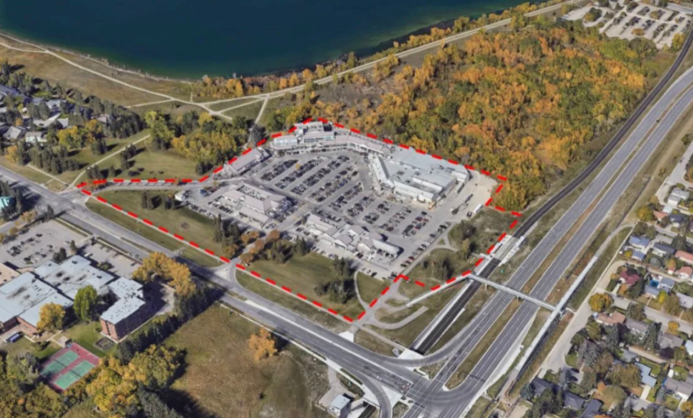
This is the current Glenmore Landing site with only one entrance in and out. You can also see the BRT station next to the pedestrian bridge the lower right corner.
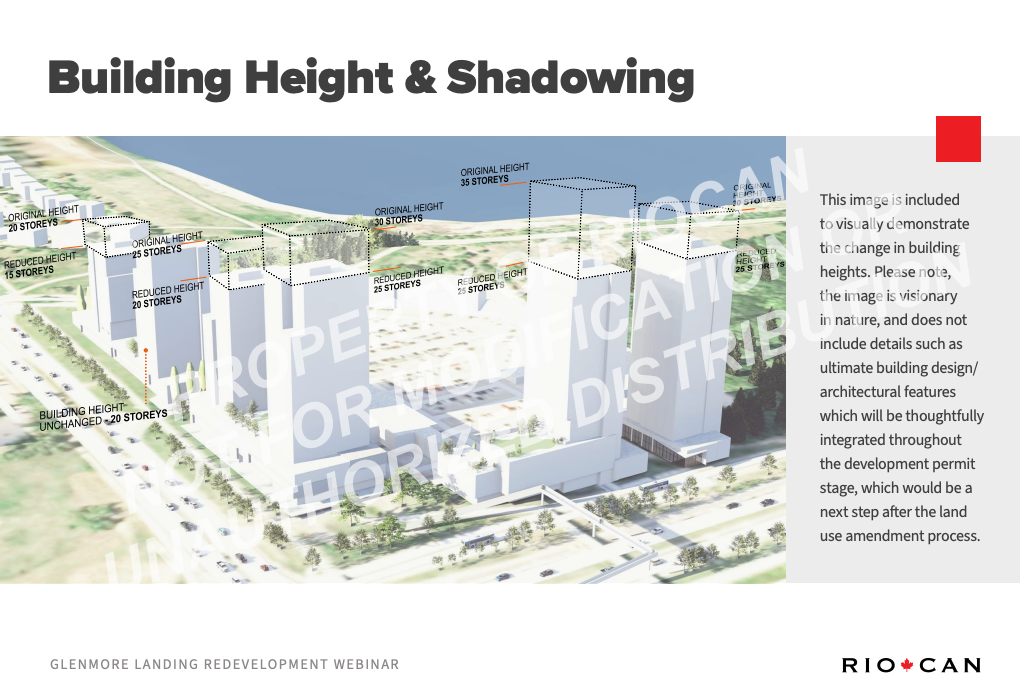
This is from the developer’s website showing the original heights of the building and the reduced heights after community engagement. Even then the development was not approved by the City.
Grace Hospital Density Grab
Recently, what looks like another “density grab” is happening at the former Grace Hospital site along 14th St. NW and 8th St N.W., just below the Jubilee Auditorium. In this case, the developer is proposing to build 15 buildings on a one and a half block site (the size of 4 football fields) called Kensington Yards. (A confusing name as it isn’t near Kensington Road and is the community of Hillhurst).
Back to the density issue. These aren’t just low-rise buildings, one could be 38 storeys, another 35, despite the fact the Riley Communities Local Area Plan (approved in March 2025) limits building heights to 26 storeys on the Grace site. Another four buildings are 20+ storeys. In total there is a whopping 213 storeys of buildings (i.e. downtown core density).
While the proposal is still conceptual, if approved it would see 1.7 million square feet of development on this 1.5 block site for 2,000 homes and commercial space at street level. For some perspective, that is just a little less than downtown’s Eighth Avenue Place twin towers. Hillhurst currently has about 3,500 homes so this would add 60% more homes on just 1.5 blocks.
The proposal also calls for 1,500 underground parking stalls (i.e. less than one per home). To give you a sense of scale, downtown’s Bow Tower’s 6-level underground parkade is slightly smaller at 1,400 stalls and the Palliser Square Parkade is a similar size.
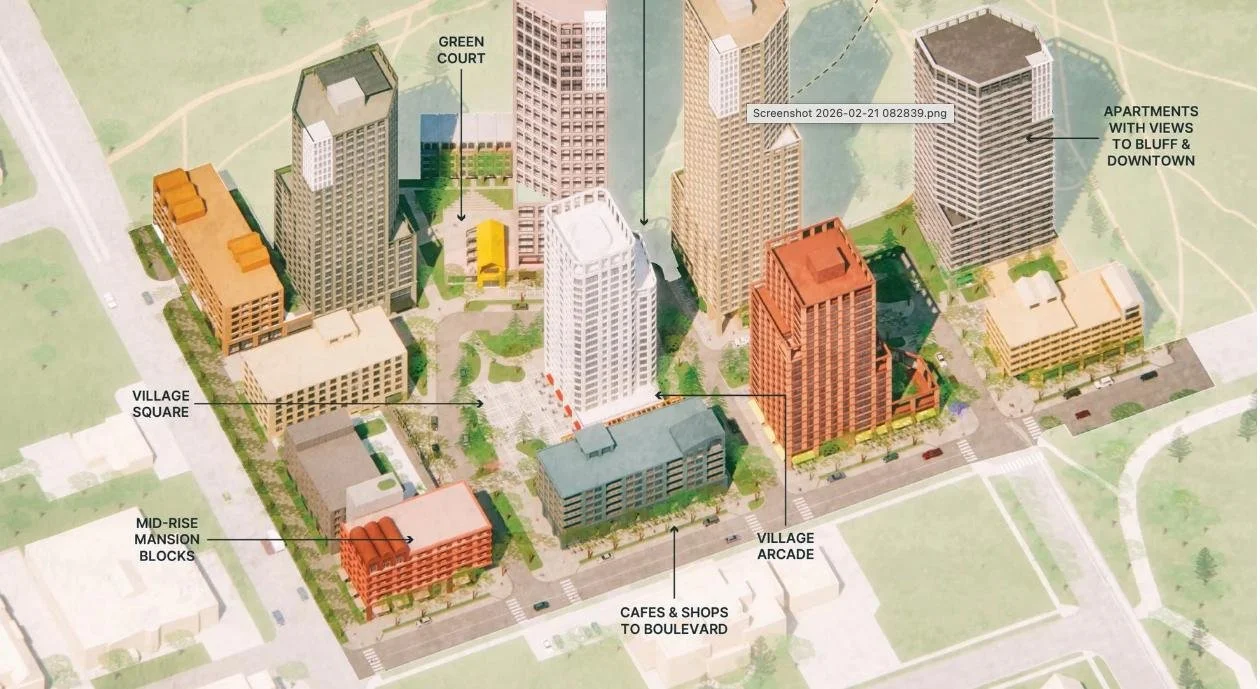
This is the model presented at the community open house illustrating the density and height of the proposed buildings.
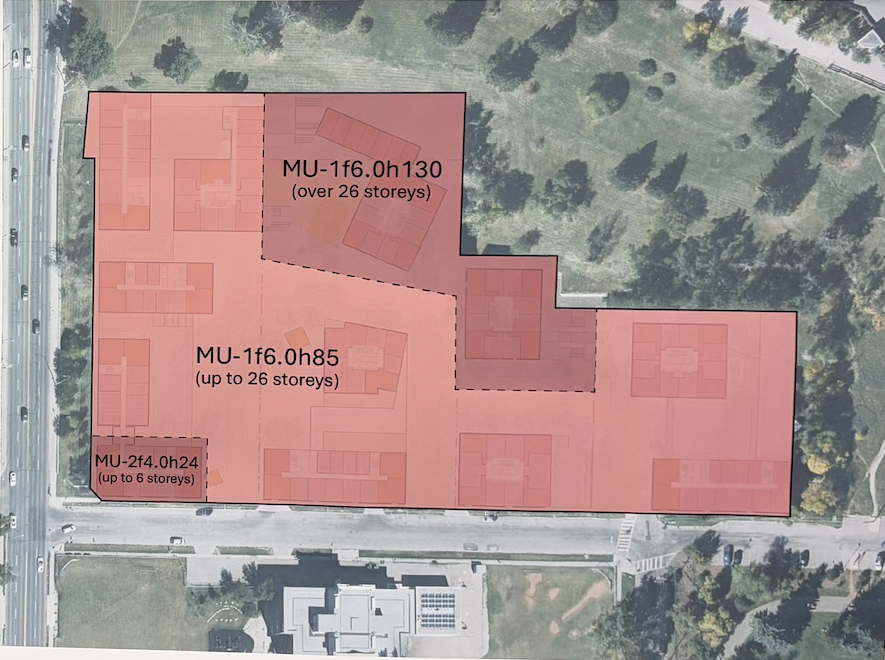
Here you can see not only the heights but also the limited access to the site from the busy 14th Street NW. What you don’t see is the steep hill that starts right at the site.
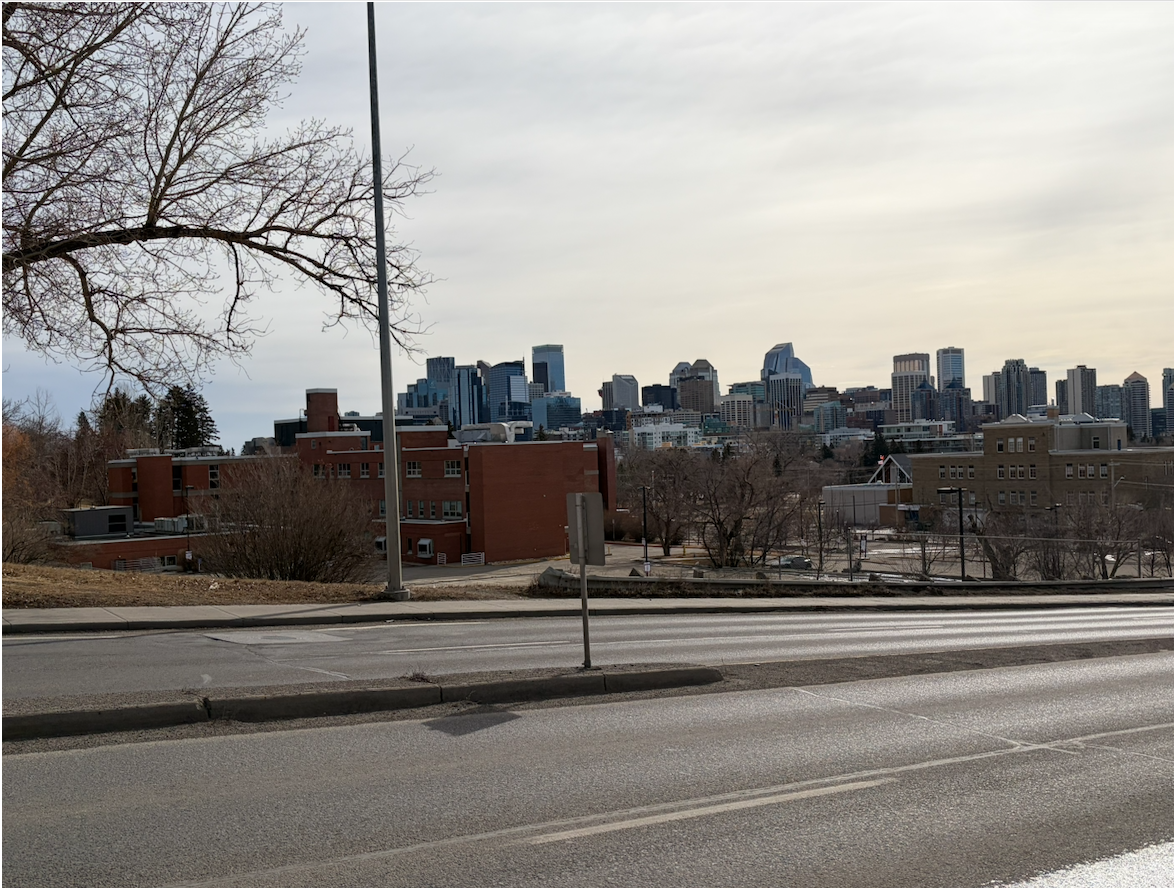
This is the site from about halfway up the hill. It is not a big site.
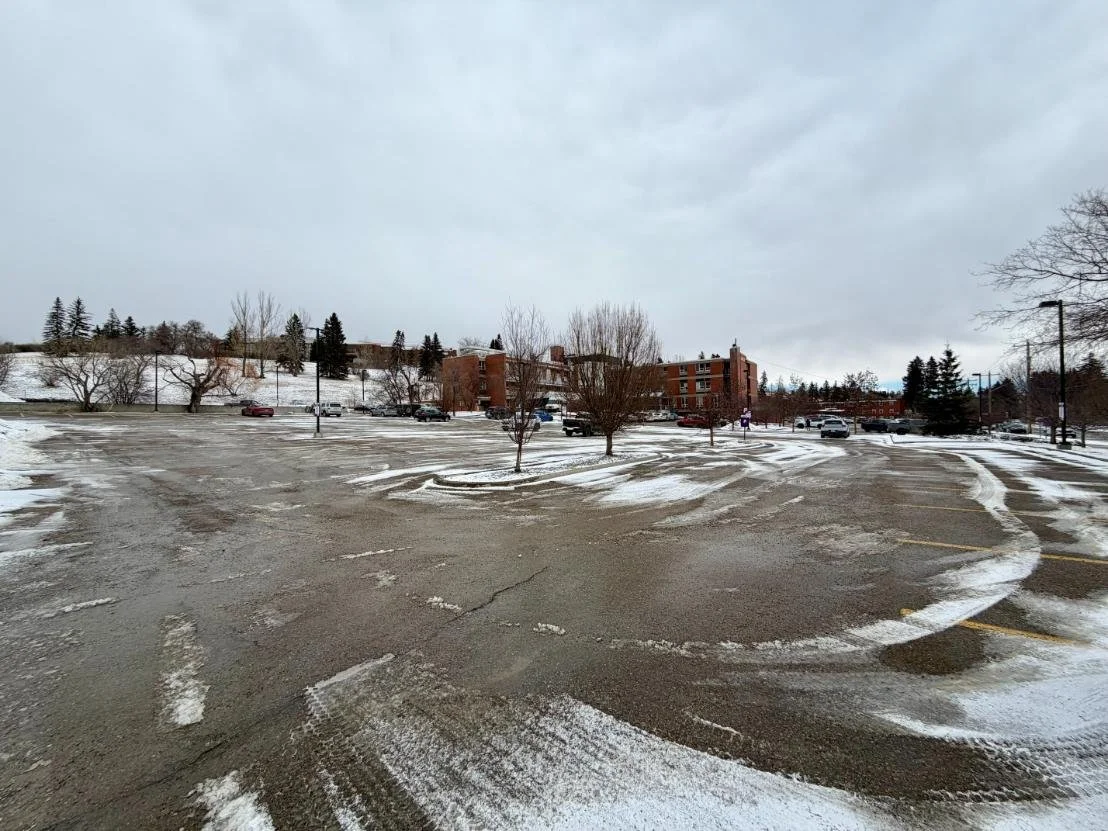
A look at the site from the corner of 14th Street and 8th Ave SW. The proposal calls for 8 buildings on the parking lot with at least one being over 26 stories.
Traffic Nightmare
This tiny site has very limited access with the North Hill immediately behind it and Riley park to the east. It also has limited ability to turn right or left onto 14th St at 8th Ave SW. and there are already traffic signals at 6th and 7th Ave SW on 14th St SW so adding a light at the bottom of the hill would not work. The Hillhurst School across the street, has 10+ school buses lined up along 8th Ave SW during the morning and afternoon rush hours.
It doesn’t take an engineer to know that if approved at this density it will be a traffic nightmare at rush hours, if not all day. However, if the developer were to dedicate say 500 homes to student housing, they could probably offer them with no parking stalls and have limited impact on traffic. Similarly, if another 500 homes were for aging-in-place housing, the need for parking and impact on traffic would be reduced. In fact, not all density has the same impact on traffic, so perhaps it does take a traffic engineer to determine what the real, versus the perceived impact with be on traffic. But how can an engineer know what numbers to use when the developer doesn’t know what they are going to build?
To reduce vehicular traffic, the developer has promised improved access to the SAIT LRT station, but that will be difficult given the steep hill and the need to weave around the Jubilee Auditorium and Alberta University of the Arts buildings.
They also indicate they will improve access to Sunnyside Station – not sure how they will do that given there are already sidewalks and pedestrian crosswalks. And there is another proposed residential development on 6th Avenue NW just a few blocks away that will add another 175 homes between Kensington Yard and the Sunnyside Station.
Plus, at rush hour there is no LRT capacity for more ridership as the trains are full by the time they arrive at either station.

School buses lined up along 8th Ave NW, immediately across from the only access point to the Kensington Yards development.
Riley Park Village
The previous Grace Hospital site back in 2021 proposed Riley Park Village, a more moderate development with 1,250 homes in nine buildings (ranging in height from 6 to15 storeys) for a total of approximately one million square feet of development. This plan was more in line with the recently approved Riley Communities Local Area Plan and was developed in consultation with the community and various urban planning experts.
It is puzzling why the new owner is asking the City to increase the density by about 70%.
Note: Riley Park Village is a better name, given the site is next to the historic Riley Park. I am a big believer that naming of major project and buildings should always link to the site’s history or place. And should be helpful in the public’s wayfinding. I love the fact, two new condos nearby on 6th Ave NW are called Ezra and Harriet - first names from the Riley family who were the original owners of the land. Hounsfield Heights adjacent to the site uses Ezra Riley’s middle name “Hounsfield” as its designation.
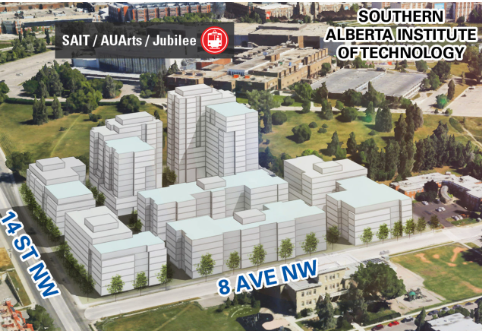
Here is the Riley Park Village proposal. Still a lot of density for a small site with limited access.
Last Word
I remain a big champion of diversifying and densifying Calgary’s established communities with new infill projects to create more housing options. But we must do it strategically, where the density makes sense and minimizes the negative impact on the existing residents. Strategic rezoning, not blanket rezoning!
The City of Calgary is wasting staff and taxpayers’ time if it is going to conduct extensive community engagement to create Local Area Plans and then just ignore them, which would happen if Kensington Yards is approved.
Will Kensington Yards become another case of “density grab?” We’ll have to wait to see!
