
Which Cities Still Treat Card Games as a Café Ritual?
A useful way to understand a city's social fabric is to watch what strangers do with idle time. In a measurable number of cities across four continents, the answer involves a deck of cards, a small table, and a coffee that goes cold before anyone notices. This article maps those cities in a sequence you can actually follow as a traveler, moving from the most accessible café-card cultures to the ones that require a little more local knowledge to enter.
One observation before the sequence: the instinct to play cards socially does not disappear when digital options multiply. If anything, cities with thriving café card cultures tend to be ones where the café itself functions as a third space, neither home nor workplace. That distinction matters for what follows. And for anyone whose interest in card games extends to structured competition, platforms built around large international player pools, like those offering poker online, have made it easier to move between casual café play and serious practice without changing cities.
The Sequence: Six Cities Worth Visiting for This Reason Alone
Step 1 - Istanbul: The Baseline Case
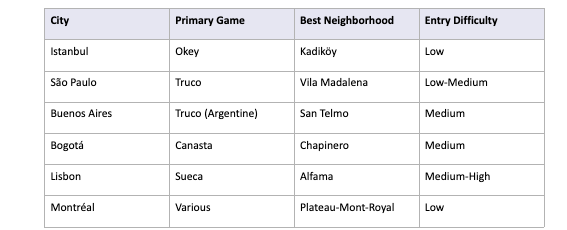
Istanbul's çay bahçesi (tea gardens) and traditional coffeehouse culture make it the clearest starting point. Okey, a tile-based rummy variant, is played openly at street-level cafés across Kadiköy and Beyoğlu. A visitor willing to sit nearby and watch for twenty minutes will almost always be invited in. The game is fast, the rules are learnable in one sitting, and the social norm around it is genuinely inclusive of newcomers.
Step 2 - São Paulo: Cards Inside the Boteco
Brazil's boteco, a neighborhood bar-café hybrid, is the natural home of truco, a trick-taking game with regional rule variations across the country. In São Paulo's Vila Madalena and Pinheiros neighborhoods, truco tables appear in the late afternoon and run well past dinner. The game is loud, argumentative in the best sense, and deeply tied to local identity. A traveler who learns even the basic hand rankings earns immediate social credibility. The São Paulo variant differs enough from the Buenos Aires version that locals will correct you, which is itself a form of welcome.
Step 3 - Buenos Aires: Truco at a Different Tempo
Argentine truco is slower and more strategic than its Brazilian counterpart, with a distinct signaling system between partners that functions almost as a private language. Cafés in San Telmo and Palermo keep card sets behind the counter, available on request, a practice that signals how normalized the habit is. Buenos Aires café culture already has a well-documented reputation for long, unhurried afternoons, and card play fits that tempo precisely.
Step 4 - Bogotá: Canasta and the Afternoon Pause
In Bogotá's Chapinero and La Candelaria districts, canasta remains a genuine café fixture rather than a nostalgic curiosity. The game suits the city's afternoon culture, which runs later than most visitors expect. Café owners in these neighborhoods often know their regular card players by name and by preferred game variant. A traveler arriving without a full group can sometimes join an existing table, though this requires more patience than in Istanbul or São Paulo.
Step 5 - Lisbon: Sueca in the Tasca
Portugal's tasca, a small neighborhood tavern-café, is where sueca, a four-player trick-taking game, gets played with the kind of focused intensity that suggests the stakes are higher than they are. Alfama and Mouraria host the most consistent scenes. Sueca requires a partner, so solo travelers face a structural barrier, but the game is worth understanding before visiting because locals respond well to anyone who can name the trump rules correctly.
Step 6 - Montréal: The Outlier in the Sequence
Montréal earns its place here not because it has a single dominant card game tied to café culture, but because its café infrastructure, particularly in the Plateau-Mont-Royal and Mile End neighborhoods, has actively supported board game and card game evenings as a programmed offering. Several cafés post weekly schedules for specific games. This is a more organized version of the phenomenon than the organic street-level play in Istanbul or São Paulo, but it produces the same outcome: strangers playing cards in a public space over coffee.
What These Cities Share
The common variable is not the game itself but the café's role as a space where time is not billable. Cities that have preserved that function tend to preserve card play alongside it. The traveler who follows this sequence, starting in Istanbul and ending in Montréal, will have played six different games in six different social contexts, which is a more precise education in local culture than most itineraries provide.
Frequently Asked Questions
Do I need to speak the local language to join a card game in these cafés?
Not always. In Istanbul and São Paulo, the games move quickly enough that gesture and observation carry most of the communication. In Buenos Aires and Lisbon, where partner signaling matters, some shared vocabulary helps, but locals are generally patient with travelers who show genuine interest in learning the game correctly.
Is café card play connected to serious competitive poker in these cities?
The games are structurally different, but the social habit of reading opponents and managing uncertainty transfers directly. Players who develop comfort with café card games often find the transition to structured formats, including online poker, more intuitive because the core decision-making instincts are already practiced in a low-pressure setting.
