
Small-Town Walls That Honour Canada’s Sports Heroes
A sports mural does something a trophy case cannot. It takes a local athlete out of the arena hallway and puts them back into the public life of the town. The wall becomes part of the walk to the rink, the café stop after a game, the family photo on a road trip and the local memory passed to kids who were not around for the original moment.
That is why Canada’s smaller towns and communities are such strong places to look for these murals. Their sports stories are rarely just about statistics. They are about the coach who opened a boxing club, the goalie who stayed rooted after a Hall of Fame career, the hockey player remembered for how he treated people, and the students who argued that overlooked athletes deserved to be seen. For visitors who move through Canada through rinks, tournaments, schedules and sports media, a sports interaction review can be one small reference point in that larger sports culture, while the murals show what a community chooses to honour in public.
The result is a different kind of travel map. These are not murals painted only to brighten a wall. They are local history, hero recognition and civic pride made visible.
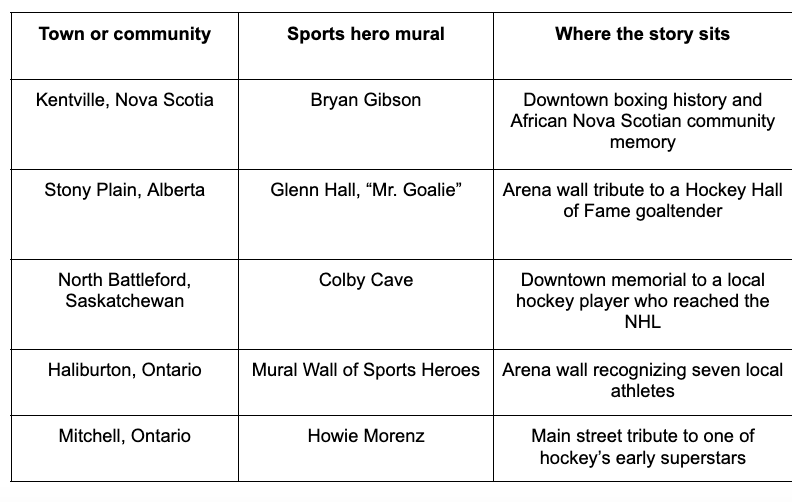
Kentville, Nova Scotia: Bryan Gibson on Main Street
Kentville’s Bryan Gibson mural is a strong example of public art working as local biography. Mural Routes identifies the piece as a 2022 mural at 390 Main Street, created collectively under organizer Jaimie Peerless to honour Gibson, an Olympian, referee and coach who founded the Evangeline Trail Boxing Club.
That detail matters. Gibson is not remembered only as an athlete who once competed at a high level. The mural also points to what he built locally: a boxing club, a coaching presence and a pathway for other young athletes. For a town, that is often the difference between fame and legacy.
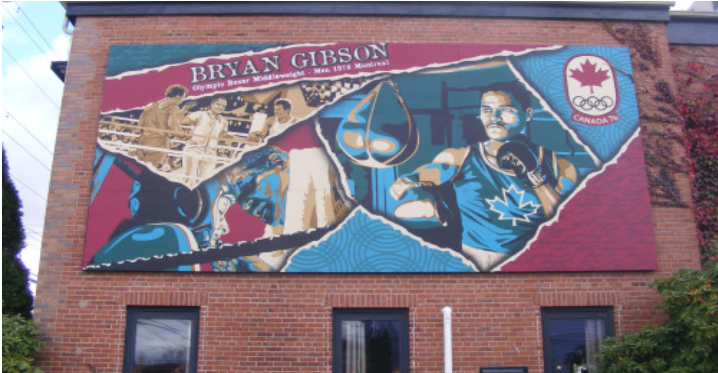
Stony Plain, Alberta: Glenn Hall outside the arena
Stony Plain’s “Mr. Goalie” mural is almost exactly where a sports mural should be: at 5300 52 Street, tied to the Glenn Hall Centennial Arena. The official Explore Stony Plain listing says the mural by Tag Kim was created in 2008 and depicts Hockey Hall of Fame legend Glenn Hall as a tribute to his career, including the Stanley Cup and his early use of the butterfly style of goaltending.
The most useful part of the mural is its local framing. Hall and his family called Stony Plain home for more than 50 years, and the town’s description connects his legacy beyond the rink through volunteering and community promotion.
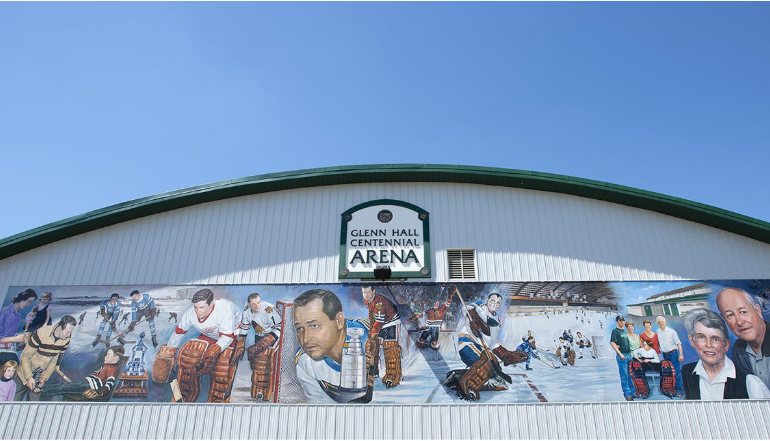
North Battleford, Saskatchewan: Colby Cave in downtown colour
North Battleford’s Colby Cave mural is the most contemporary example in this group. Local coverage reports that the mural covers the wall of the 1201 101st Street building in downtown North Battleford and measures 2,400 square feet.
The mural follows Cave’s hockey path from Battlefords minor hockey through junior hockey, the AHL and the NHL, including time with the Boston Bruins and Edmonton Oilers. It also carries the personal motto associated with Cave and his wife Emily: “Be somebody that makes everybody feel like a somebody.”
That is why this mural feels less like a sports résumé and more like a community message. It tells young players that the town remembers not only the level reached, but the way a person moved through it.
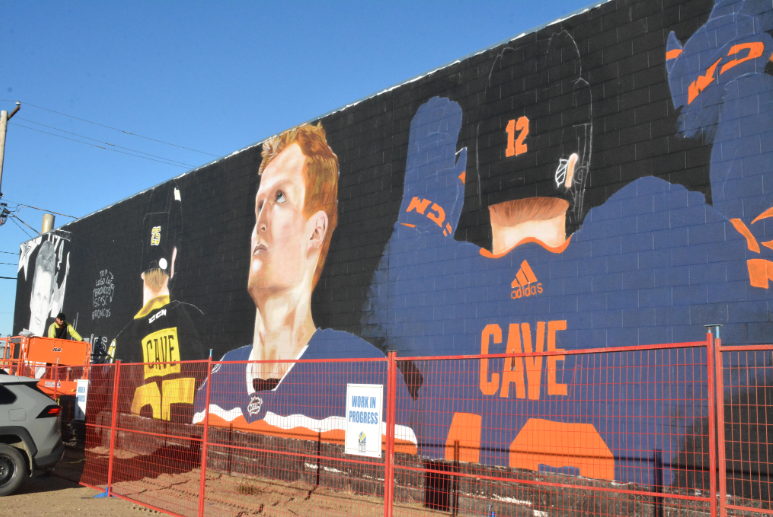
Haliburton, Ontario: a wall that expanded who gets remembered
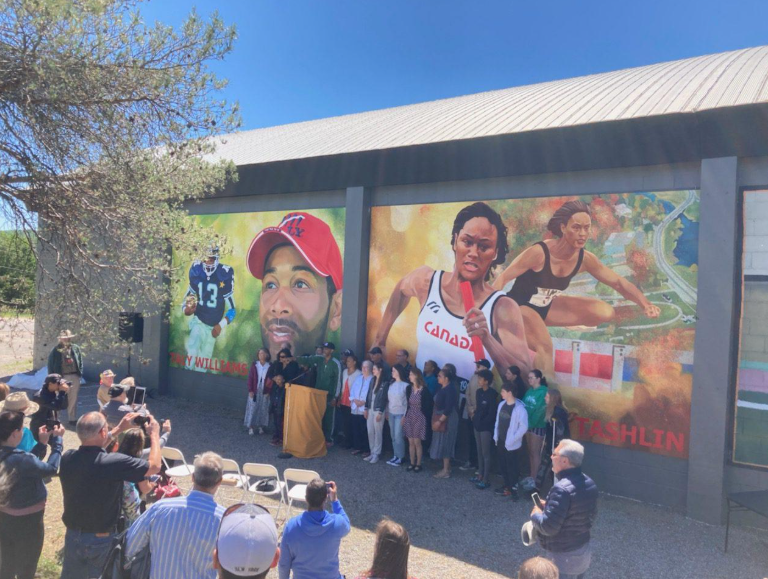
Haliburton’s Mural Wall of Sports Heroes is valuable because it shows how public memory can be revised. The Municipality of Dysart et al says seven large murals on the outside of the A. J. LaRue Community Centre celebrate local sports heroes. The first two recognized NHL players Ron Stackhouse and Bernie Nicholls, with later murals adding Mike Bradley, Cody Hodgson and Matt Duchene.
The final two banners, installed in 2022, honour siblings Lesley Tashlin and Taly Williams. The municipal history notes that Tashlin became Canada’s fastest female 100-metre hurdler in 1995 and competed at the 1996 Olympic Games, while Williams played football at the University of Waterloo and later in the CFL with the Toronto Argonauts and Hamilton Tiger-Cats.
This is the kind of mural story that helps readers understand why walls matter. Recognition is not neutral. A mural can correct an absence as much as it can celebrate an achievement.
Mitchell, Ontario: Howie Morenz on a main street wall
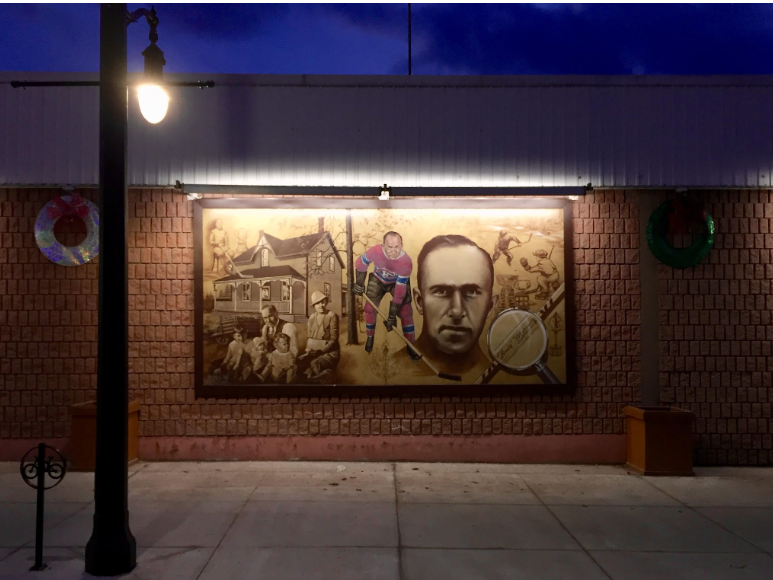
Mitchell’s Howie Morenz mural gives the article a deeper hockey-history layer. Morenz was born in Mitchell, played for the Montreal Canadiens, Chicago Black Hawks and New York Rangers, won the Stanley Cup three times with Montreal, and became one of the original Hockey Hall of Fame inductees in 1945.
The mural itself is part of Mitchell’s main street memory. Puckstruck documents the Morenz mural on the side of a Valu-Mart building in Mitchell, with a photo by Stephen Smith showing the mural lit at night and framed like a public heritage panel.
A mural like this works because Morenz is not just a national hockey name. He is also a local origin story. For visitors, that can turn a stop in a small Ontario town into a reminder that major sports history often begins far from the big arenas.
Why these murals work better than generic public art
The common thread is not paint. It is specificity. Each mural answers three questions at once:
Who did this place help shape?
What did that person give back to sport or community?
Why should a visitor stop here instead of simply driving through?
That is what separates sports-hero murals from generic beautification projects. A landscape mural may make a wall more attractive. A local sports mural can make a town more legible.
For readers, these murals are also practical travel prompts. They sit near arenas, downtown blocks, community centres and main streets, which makes them easy to fold into a weekend tournament, a hockey history drive or a family road trip. You do not need a formal museum visit to understand the story. You only need the address, the wall and a few minutes of attention.
The takeaway for Canadian mural towns
The strongest Canadian sports murals are not trying to make small towns look bigger. They are doing the opposite. They make local memory harder to miss.
Kentville uses a downtown wall to remember a boxer and builder. Stony Plain turns an arena exterior into a goalie’s community biography. North Battleford gives grief, pride and youth hockey a shared public image. Haliburton shows how a wall can be expanded when recognition was incomplete. Mitchell keeps an early hockey superstar visible on the main street where a visitor can still pause.
That is the real travel value. These murals give readers a reason to look beyond the usual postcard Canada and notice the heroes painted into the places that raised them.
