
What Kensington Market in Toronto Tells You About the City It Sits In
There is a stretch of Augusta Avenue in Toronto where a fishmonger, a vintage clothing rack, a taqueria, and a cheese shop all share the same half-block. On a Saturday morning, the sidewalk fills up fast. Nobody is in a hurry. A man props open a cooler of Caribbean hot sauce outside his door. Across the street, someone paints a new mural over last year's. This is Kensington Market — and if you spend a few hours here, you come away with a clearer picture of what Toronto actually is, beyond the glass towers and the subway maps.
The neighbourhood sits between Spadina Avenue and Bathurst Street, College Street to the north, Dundas Street West to the south. It is small — you can walk the main streets in under twenty minutes. But the density of what happens inside those borders is hard to find elsewhere in the city. People come here to shop, eat, argue about rent prices, and occasionally just stand still for a moment. Some evenings, especially on Pedestrian Sundays when cars get blocked off from the main streets, the whole area starts to feel less like a shopping district and more like a town square. Others visit from across the city, or book accommodation nearby so they can explore at their own pace not unlike browsing through https://manekispincasino.com in the evening after a long day on foot, picking through something at your own speed without anyone pushing you along.
A Neighbourhood That Changed With Its Residents
Kensington did not start out as a market. In 1815, a British loyalist named George Taylor Denison bought the land as part of a large private estate. By the 1850s, his family had sold off plots. Irish and Scottish labourers moved in, built Victorian row houses, and settled into a working-class neighbourhood that looked more or less like dozens of others in 19th-century Toronto.
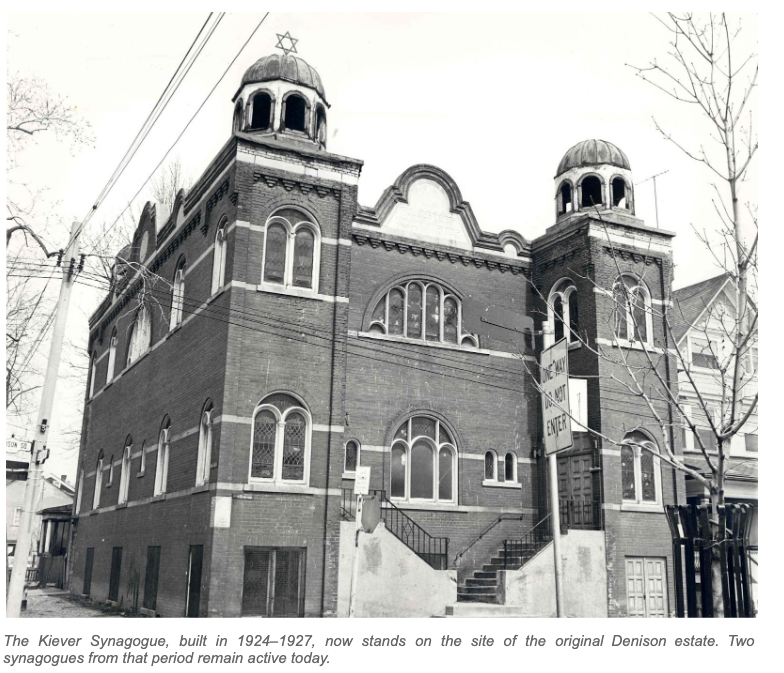
What changed things was immigration. In the early 1900s, Eastern European Jewish families began arriving, many of them moving from an overcrowded area further east known as the Ward. They converted the front rooms of Victorian houses into small shops — adding counters, canopies, outdoor stalls. By the 1920s, the area was home to roughly 80 percent of Toronto's Jewish population and had earned the nickname 'the Jewish Market.' Two synagogues from that era still stand: the Kiever Synagogue on Denison Square, built between 1924 and 1927, and the Anshei Minsk Synagogue on St. Andrew Street, opened in 1930.
After the Second World War, another wave arrived — Italians, Portuguese, Eastern Europeans. Then in the 1960s, the federal government began removing racial discrimination from immigration criteria, which opened Canada to people from the Caribbean, South Asia, and East Asia. Each group left something behind: a food tradition, a building style, a way of doing business. By the time the area became a National Historic Site of Canada in 2006, the layers had become part of the physical fabric of the streets.
The Kiever Synagogue, built in 1924–1927, now stands on the site of the original Denison estate. Two synagogues from that period remain active today.
What the Streets Look Like Now
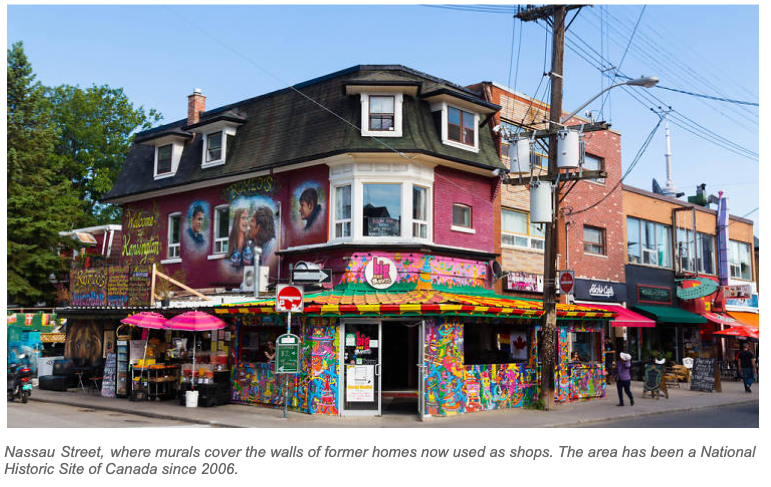
The physical layout of Kensington Market has not changed much in a hundred years. Streets are narrow — narrow enough that on busy afternoons, pedestrians drift naturally into the road. Buildings are low-rise, mostly two storeys, with retail at street level and apartments above. Many storefronts still show the bones of the Victorian houses they grew out of: brick walls, bay windows, uneven additions built out toward the sidewalk.
What fills those storefronts shifts constantly. The current mix includes independent grocery shops with produce stacked outside, bulk spice sellers, vintage clothing stores, butchers, fishmongers, cafés, bars, a handful of cannabis dispensaries, and several Latin American restaurants that took root after a wave of immigration from Central and South America in the 1990s. There are also record shops, tattoo parlours, and galleries that appear, disappear, and occasionally come back under different names.
One building on Baldwin Street, now a Caribbean food shop, once housed a succession of Jewish-owned businesses going back to the 1920s, followed by a Portuguese-owned café that ran for more than fifty years before closing. That kind of layered history sits inside almost every address in the neighbourhood — you just have to know to look for it.
Nassau Street, where murals cover the walls of former homes now used as shops. The area has been a National Historic Site of Canada since 2006.
Numbers That Explain the Neighbourhood
The 2006 Canadian Census gave researchers a snapshot of how differently Kensington functions compared to the rest of Toronto. The contrast is striking:
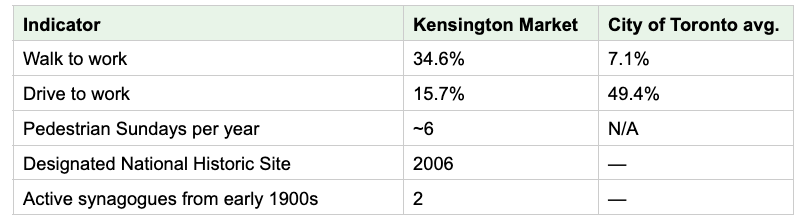
The walking-to-work figure is not just a curiosity. It reflects something structural about how the neighbourhood works. Kensington Market has almost no parking. That is not an accident — it is a consequence of the street layout, which was built for foot traffic and hand carts, not cars. The result is a place where the pace of movement stays slow enough that you notice things: a new sign, a moved table, a shop that opened where another one closed.
Why the Market Still Resists Change
Kensington Market nearly disappeared in the 1960s. A city planning proposal at the time called for demolishing the small houses to make way for large apartment blocks — a pattern that remade several Toronto neighbourhoods during that decade. Residents and local businesses fought back, and the plans were eventually shelved after David Crombie was elected mayor, bringing a different approach to urban development with him.
Since then, the area has held its form through several economic cycles. When the Portuguese shop owners who had run businesses here for decades began to retire in the 1990s, Latin American entrepreneurs moved in and opened food stalls and small restaurants. When a long-running café closed in recent years, an independent hemp bakery took the space rather than a chain. The turnover is real — rents have gone up, and several longtime tenants have left — but the character of the street-level activity has stayed closer to its roots than most comparable areas in the city.
A few factors help explain why:
Toronto's Official Plan restricts large-scale development in the area and requires new buildings to maintain low-rise proportions with retail at street level.
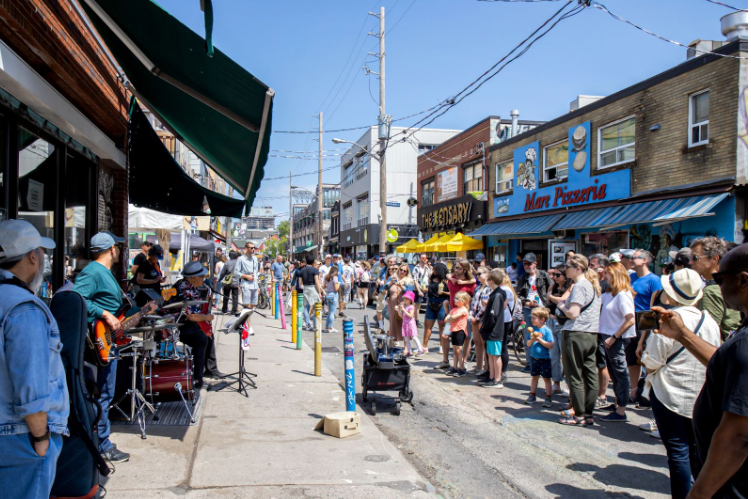
The Pedestrian Sunday events, held roughly six times a year since 2005, close Augusta Street, Baldwin Street, and Kensington Avenue to vehicles and keep the area oriented toward foot traffic.
The National Historic Site designation, granted in 2006, adds a layer of protection that makes it harder to rezone or redevelop without scrutiny.
The narrow streets and minimal parking make the area structurally unsuitable for high-volume retail, which limits the type of business that can operate profitably here.
A high proportion of residents walk to work and live near the market, which sustains a local customer base that does not depend entirely on tourist visits.
On Pedestrian Sundays, sections of Kensington Avenue close to vehicles. The events have run roughly six times a year since 2005.
What It Tells You
Toronto is often described as a city that grew by addition rather than by replacement. New arrivals came, settled in specific pockets of the city, built communities, and eventually moved elsewhere as their economic footing improved — leaving behind traces that the next group then built on top of. Kensington Market is one of the few places where that process is still visible at street level, in the architecture, in the food, and in the rhythm of daily life.
It is also one of the few neighbourhoods in Toronto where you can walk in, spend an afternoon moving between a dozen different food traditions, and not feel like you have been directed toward any of it. There are no information boards at the entrance. No curated experience. Just streets that have accumulated a lot of history and have not yet been smoothed over into something easier to manage. That, in its own way, is a reasonable summary of the city.
