
Do we really need downtowns anymore?
“Do we need downtowns anymore?” I have been asking myself this question for decades especially when I regularly visit Canadian cities like Hamilton, London, Winnipeg and Edmonton, who all have downtowns that have been in decline for the past 50+ years, despite several revitalization plans.
This is not just a Canadian problem. Recently I read Dallas has 50% vacancy its largest office towers (nicknamed Zombie Towers) and Denver has 40% office vacancy overall. What can they do with millions of square feet of empty office space? Can they copy Calgary’s successful “office to residential” conversion program?
Are cities across North America just spending good money after bad? Does downtown revitalization work? Calgary has had at least 3 failed downtown revitalization plans over the past 50 years.
Do cities in the 21st century need a downtown in the conventional (20th century) sense i.e. a city’s major employment engine, its arts and culture centre and its major shopping, dining and entertainment destination.
In my experience, the only downtowns that are vibrant today are ones that are tourist attractions. Perhaps we should abandon the name “downtown” all together as the first step in a mega re-think of city building and urban planning.
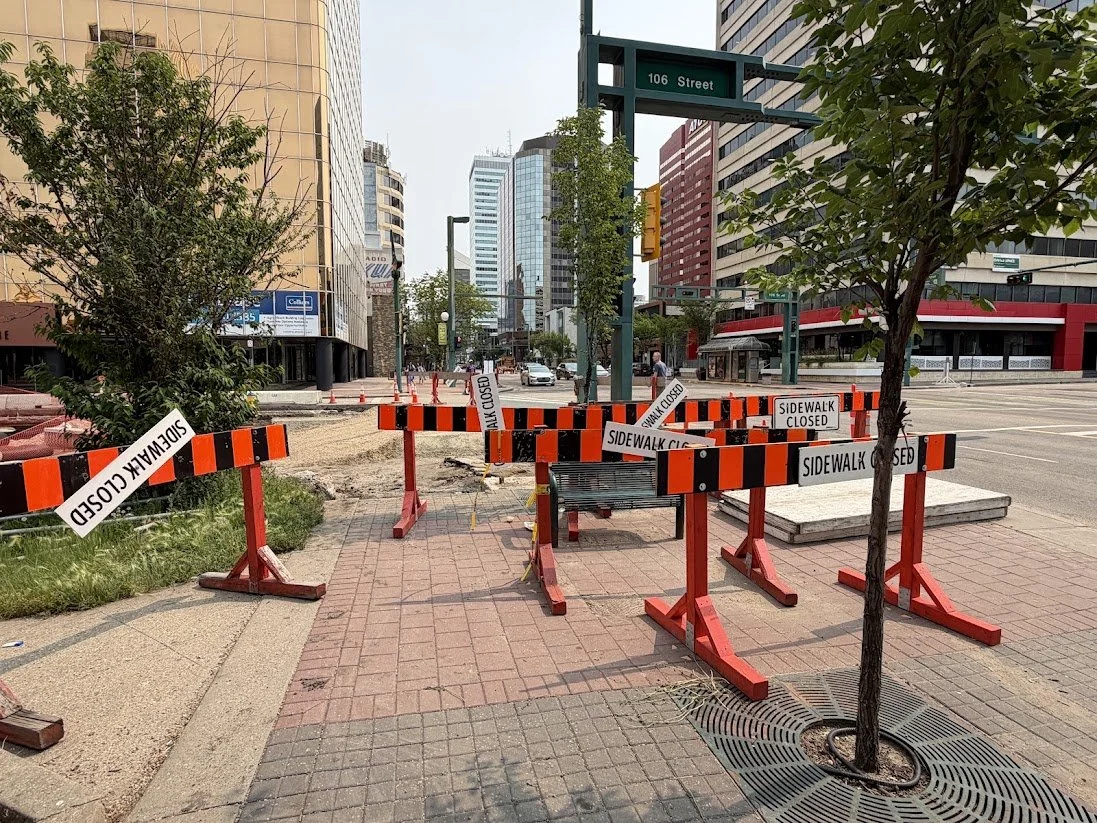
This is downtown Edmonton, but could be almost any Canadian downtown where multiple projects are under construction in an attempt to make them more attractive places to live, work and play. However, in the meantime the construction is driving people away from downtown. The big question will they ever come back? Is there a compelling reason to come downtown anymore?
Case Study: Winnipeg
Living in downtown Winnipeg for two years in the late ‘70s as a post graduate student, I loved the charm of the Exchange District and the buzz of Osborne Village (think Calgary’s Kensington Village). Even Portage Avenue had some vitality with its two huge department stores – Hudson’s Bay and Eatons.
Fast forward to May 2026 when I spent two days exploring its downtown. The first day I started at the old Bay Parkade where there was only one car parked at 10am on a Saturday. (About 8 cars were there when I returned several hours later. FYI. It is across the street from the Winnipeg Art Gallery and would be the most logical place to park).
On our walk over to Portage Avenue, many of the storefronts were empty. The historic Hudsons Bay store was boarded up as construction has begun on repurposing it, but there was no signage to say what the new vision was; nothing to create some excitement for what is coming.
Across the street, Portage Place, a failed late 20th century attempt at a downtown indoor retail mall (most have failed) was the same story. The outside was tired, the inside almost empty. It too is undergoing a major repurposing, but again there was no attempt to promote an exciting new project.
Wandering down Portage Avenue, most store fronts were empty; a transit shelter was full of garbage. It was depressing. It felt like a Zombie Downtown?
Eventually we ended up at Portage and Main, famous for being the windiest corner in North America (it did not disappoint). I was curious to see if re-opening the corner to pedestrians to cross at street level (after being closed for 46 years) made any difference to the street ambience. Unfortunately, there were no pedestrians, just us. And this was not surprising as there isn’t much to see or do at the corner.
We decided to head to the old underground concourse (which was the only way to cross from 1979 to mid 2025) to see what it was like. The entrance was filthy with garbage and once underground it felt like you were in a Zombie Movie. We made our way to the other side and to find the plaza in front of the Fairmont Hotel with its bronze sculptures was likewise deserted. So much for public art creating urban vitality.
We continued our walk over to the Exchange District. Again, we were mostly alone. There were a few shops open with The Goodwill having perhaps the most animation. The Exchange District hasn’t changed much since I first visited in 1976. It seems like as one shop opens, another closes. Yes, it has the one of the best collections of early 20th century buildings in North America, but it isn’t the result of preservation but rather the lack of prosperity to repurpose them. Fifty years of revitalization planning and discussions regrettably seems have been a waste of time and money.
We then wandered over to Canada Life Centre, Winnipeg’s NHL arena (event centre) which is located right on Portage Avenue (the old Eatons department store site). The arena anchors Winnipeg’s SHED (Sports, Hospitality, Entertainment District) which includes its Convention Centre, two office towers and True North Square. It is very similar to Edmonton’s Ice District, but on a smaller scale and what Calgary is currently creating at Stampede Park. There wasn’t a soul there and the restaurants were all closed on this Saturday. To be fair, I expect there is some animation during the week from office workers, but it really is event oriented - conventioneers, hockey fans and concert goers – not everyday vitality. Not the everyday vitality a downtown needs to be viable. The creation of True North Square has cannibalized pedestrians and office workers from the rest of downtown, as the Ice District has done in Edmonton.
The same is true for Winnipeg’s Theater Museum District on Main Street next to City Hall, which is a ghost town except for an hour before and after performances. So much for public investment in the arts as a catalyst for urban renewal.
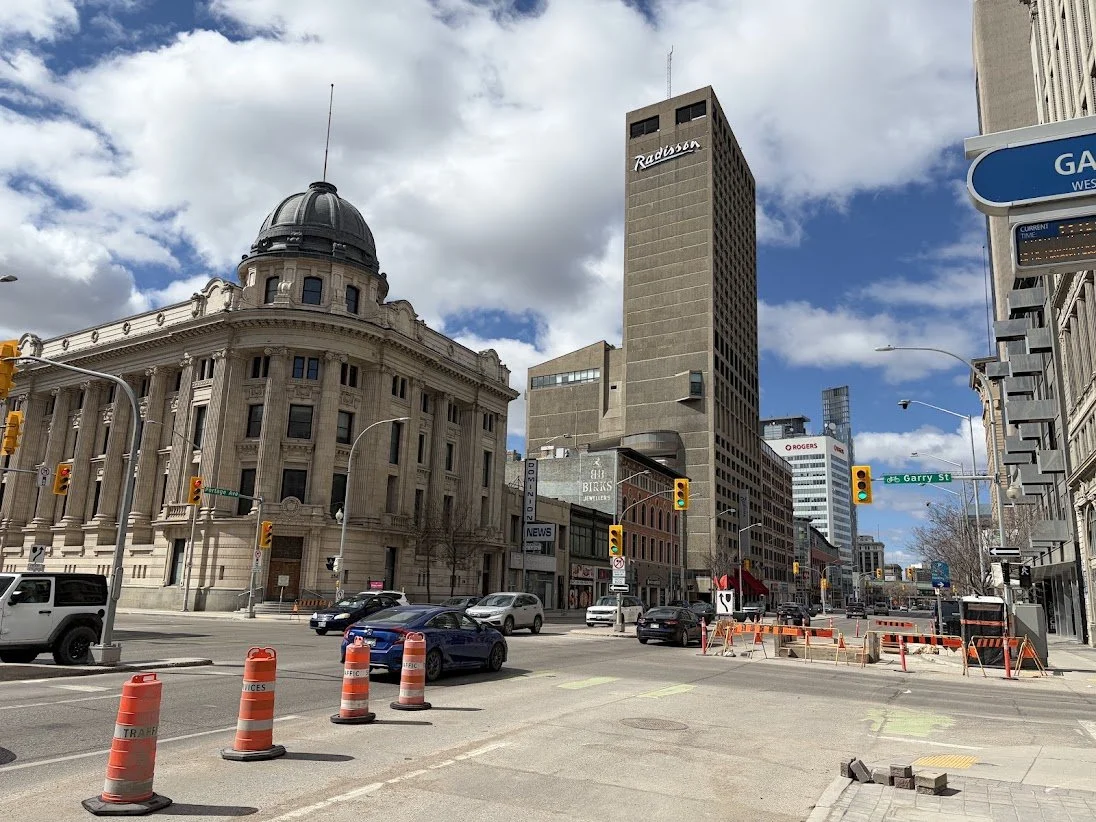
I spent two days recently exploring Winnipeg’s downtown on a weekend and found the streets were mostly empty. Winnipeg has been trying to revitalize its downtown and Portage Avenue for 50+ years without any success. There is no reason to come downtown shop anymore as the department stores are all closed. In fact most of the store fronts along Portage Avenue are closed or no longer have retail.
The Forks
The next day (Sunday) we explored The Forks, a mixed use public space at the confluence of the Red and Assiniboine Rivers southeast of downtown core, located behind Union Station (Winnipeg’s heritage train station, which has a grand total of 12 Via Rail trains arriving per week.)
The Forks wasn’t exceptionally busy but there were people. Surprisingly we didn’t see anyone go in or out of the Canadian Museum for Human Rights (iconic architecture), or the Children’s Museum. The Forks Market and Terminal were animated with people eating, shopping and chatting. The Dance School was hopping and tapping.
Though too warm for ice skating and too cold for the man-made beach and boating, I could image the plaza at The Forks being a busy place when the weather conditions are right. Strangely, the Indigenous Education Centre is closed on weekends.
It would appear if a Winnipegger wanted to go downtown on the weekends to shop, eat and play, it would be to The Forks, not downtown. The city isn’t big enough to support two urban playgrounds. The unintended consequence of the creating of The Forks has been to enhance the decline of the Winnipeg’s downtown.
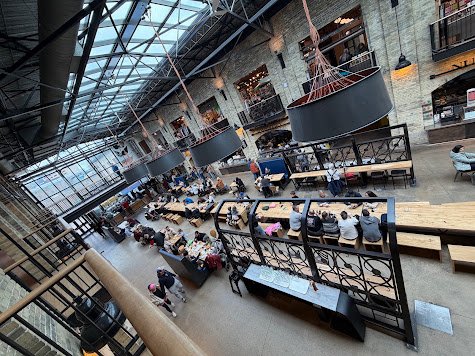
I did find some animation at The Forks but only in the market buildings the rest of the site was empty.
False Promises
The idea that museums, arenas, convention and art centers are catalysts for private sector development next to them is misleading. Yes, Winnipeg’s True North Square and Edmonton’s Ice District have resulted in new development next to them but at the expense of the rest of their respective downtowns. There has been no incremental increase in pedestrian activity. The new office and hotel spaces have emptied out other buildings in the downtown.
Today, vibrant downtowns are visited by locals mostly for events, i.e. sports, exhibition openings, theatre, concerts, trade shows or festivals.
In Calgary, the placement of one of Canada’s largest museums and performing arts centres and a convention centre/hotel complex at the at the east end of Stephen Avenue (a pedestrian mall) in the ‘70s, resulted in little private sector investment nearby. The area has struggled for 50+ years to create the desired nightlife and weekend vitality.
It will be interesting to see if a renovated Glenbow, expanded Arts Centre, new Olympic Plaza and upgraded Stephen Avenue all currently underway will be successful in creating the evening and weekend animation of one of Canada’s best heritage streets.
Based on urban planning theory Stephen Avenue should be one of Canada’s most vibrant streets. It is home to a major museum/art gallery, five soon to be seven performance spaces, a major tourist attraction, dozens of restaurants and cafes, a convention center, major plaza, an indoor shopping centre and park. It is just a block from the city’s transit corridor - and within easy walking distance for 100,000+ office workers, 30,000+ residents and several major hotels. Yet, it struggles. Urban planning theory often doesn’t work in reality.
Every medium size Canadian city has failed at revitalizing its downtown with an indoor shopping centre (all the rage in the 70s and 80s) as they not only don’t have the critical mass of employees, and City Centre residents to support them, but they don’t have the tourists.
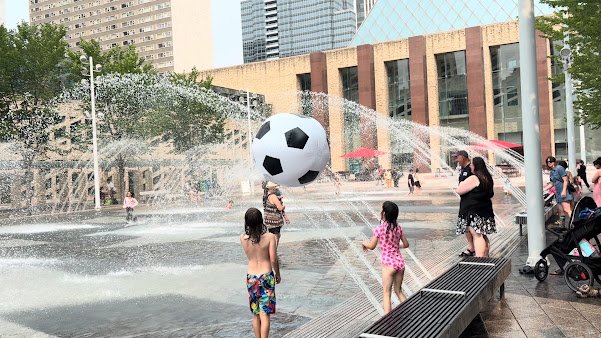
I did find some vitality in Edmonton at the wading pond next to City Hall. Families were having lots of fun throwing large inflatable soccer ball in the fountains. Too often public spaces are not designed with features that are nice to look at but don’t engage the public to stay and play. Downtowns need more of this.
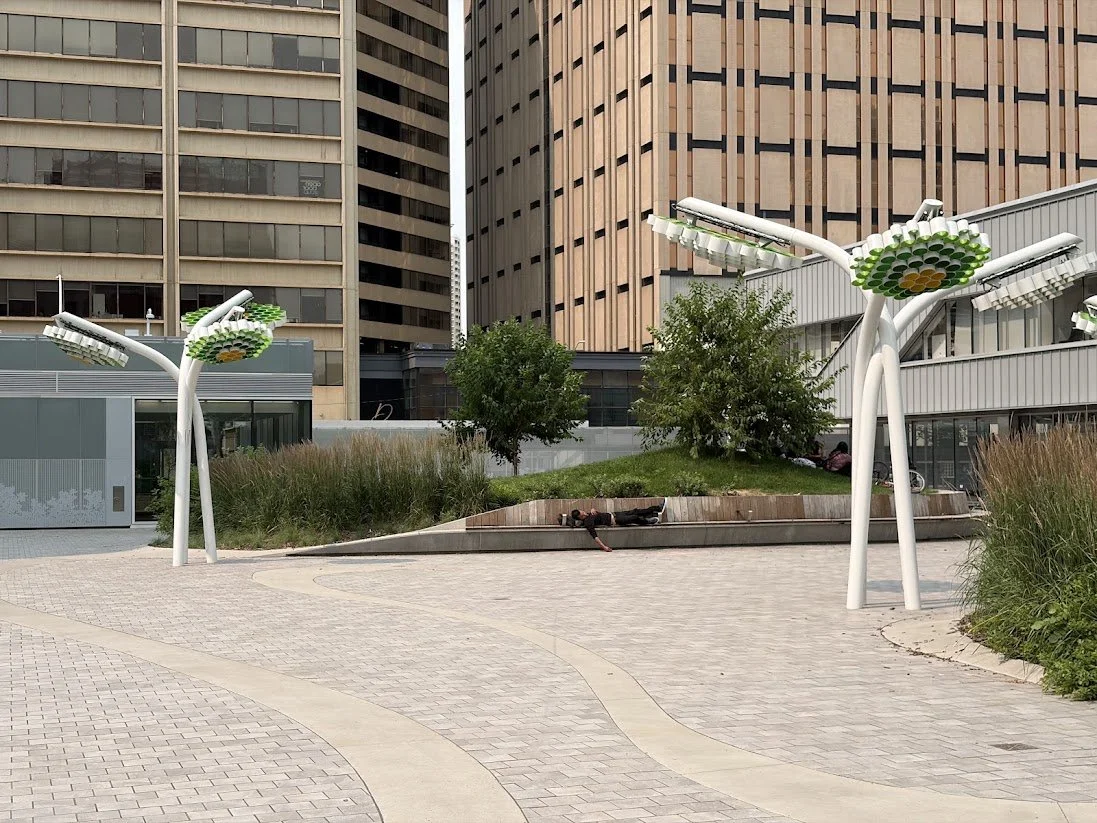
Here is an example of new plaza behind Edmonton’s downtown public library just a block away from the wading pool above. It is an example of a poorly located and designed space. It is hidden from the street and there is no reason to linger. It attracts undesirable activities, which were happening here, but I have not shown them. Downtowns need better public spaces not more. I found two other new parks along Jasper Avenue as part of the city’s downtown revitalization that were also empty on a nice weekend afternoon.
Downtown must be a tourist attraction
Vibrant downtowns (i.e. those with evening and weekend vitality) are downtowns that are a tourist attraction. It is the tourists, not the locals who are wandering the downtown looking for things to do and hang out. Good luck getting people living in the suburbs to come downtown to shop or dine anymore - the suburbs have better shopping and just as good dining opportunities. Even those living on the edge of downtown, don’t venture into the downtown core as they have cafes, restaurants, pubs and music venues in their ‘hoods.
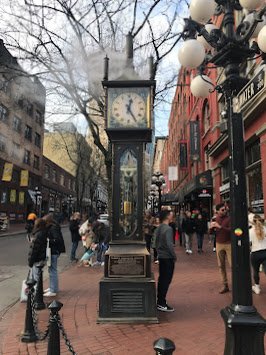
Gastown is huge tourist destination in downtown Vancouver.
Think about it! Vancouver, Toronto and Montreal’s downtowns are all recognized urban playgrounds nationally and internationally for tourists.
Tourists actually travel to those cities to stay and play in the downtown.
In addition, downtown Vancouver benefits from being an international cruise ship destination.
Toronto’s downtown benefits from having Canada’s only major league baseball and basketball team so it has more event tourism than any Canadian city. Montreal’s downtown has a long history of being a party place for tourists and benefits from being home to 320,000 post-secondary students, including 40,000 international students the majority of whom live and learn in downtown. Students come and go at all times of the day and night, and they have lots of cash to spend - theirs, parents and grandparents.
But when it comes to Calgary, Edmonton and/or Winnipeg’s downtowns, they are not widely recognized as a tourist destination. For tourists, Calgary might be a one day stopover while waiting to catch a plane home from Banff. Even Ottawa’s downtown with all its museums and being the capital of the country struggles to create downtown vitality.
I expect you could measure the vitality of any downtown by the number of hotels and Airbnb’s it has.
A quick check of CBRE’s downtown hotel data finds:
· 20,000 rooms in Toronto
· 14,000 rooms in Montreal
· 9,000 rooms in Vancouver ***
· 6,500 rooms in Ottawa
· 5,500 rooms in Calgary
· 4,500 rooms in Edmonton
· 2,500 rooms in Winnipeg
*** Vancouver’s downtown hotel rooms doesn’t include the 150+ cruise ship visits representing 1.4 million tourists.
Airbnb Downtown listings:
· 4,500 in Toronto
· 2,800 in Montreal
· 1,300 in Calgary
· 900 in Vancouver (short stay Airbnbs are prohibited by law)
· 200 in Edmonton
· 150 in Ottawa
· 100 in Winnipeg
For comparison purposes, Manhattan has about 95,000 hotel rooms, Paris has a similar number, with Chicago having 48,000 in its central business district.
While more research is needed, it would seem downtown vitality is indeed directly related to its status as a “tourist destination” nationally and internationally.
Last Word
Downtowns have been in decline for 50+ years. First, it was people didn’t want to live downtown hence, the flight to the suburbs. Then they didn’t want to shop, dine or go to the cinema downtown. Today people don’t even want to work downtown.
The heyday of the downtown was in the middle of the 20th century. It is not the 1950s or ‘60s anymore. At what point do we face the reality that the concept of the 20th century downtown as the heart and soul of a city is antiquated?
City Councils and urban planners would be wise to recognize this and rethink what the future of downtowns will be. Unfortunately, I am not sure anyone knows, but they certainly aren’t going to look like they did in the middle of the 20th century.
Perhaps we should abandon the name “downtown” all together as the first step in a mega re-think of city building and urban planning.
