
Baden-Baden rewards a visit that leaves time between attractions. Its thermal baths are an obvious draw, but the German spa town also offers a walk through covered promenades, formal gardens and museum architecture. Start at the Trinkhalle, continue past the Kurhaus and follow the Oos towards Lichtentaler Allee. The route makes sense as a sequence of places designed for people to spend time, not simply to pass through.
Treat this as a flexible half-day plan, with extra time for an exhibition or a café stop. The outdoor walk and an indoor visit are separate choices. Check current museum opening hours before committing to the latter, and leave the walking portion adjustable. There is no need to reach the far end of the park to understand why it belongs to the town's cultural landscape.
Begin under the Trinkhalle columns
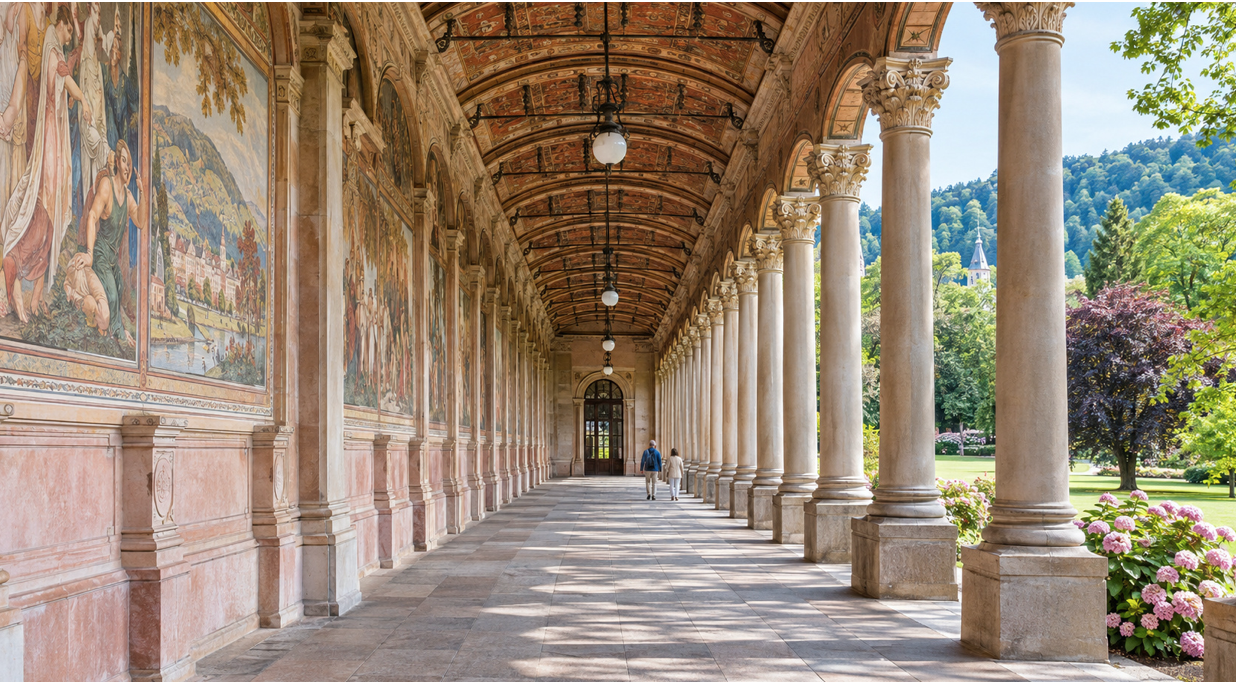
The Trinkhalle offers a useful first lesson in looking slowly. Built between 1839 and 1842, its open walkway extends for 90 metres. Sixteen Corinthian columns frame the garden side, while 14 murals by Jakob Götzenberger depict regional stories and legends. Rather than treating the entire building as one photograph, choose a single mural, then step back to see how the repeated columns organise the view.
The covered space is especially interesting as a transition between building and garden. You can remain sheltered while looking outward, or move into the grounds and see the colonnade as a continuous façade. Those two positions produce different photographs without requiring a different attraction. Keep the path clear when stopping, particularly where other visitors are moving through the same narrow perspective.
Baden-Baden belongs to the UNESCO property The Great Spa Towns of Europe, which brings together 11 towns in seven countries. The designation recognises more than bathing facilities. It includes the buildings, parks and social spaces that developed around European spa culture. That wider view explains why the next stop is the Kurhaus rather than another pool.
Read the Kurhaus as a social building
At the Kurhaus, begin with the exterior and its relationship to the Kurgarten. The building helps explain how entertainment became part of a spa visit. Music, conversation and gaming occupied a setting in which the room itself contributed to the occasion. The useful travel question is not simply what happened inside, but why people wanted to gather in this particular place.
The distinction becomes clearer when compared with digital casino entertainment. A streamed table can carry a dealer's voice, a sequence of gestures and the progress of a game to a remote participant. It cannot carry the walk through a garden, the scale of a room or the social geography of a resort town. Those are features of a destination, not of the game alone.
For a Canadian reader, Spin Casino's live dealer casino provides a concrete example of the table-based format separated from a physical travel setting. At the Kurhaus, that distinction draws attention back to the place. The architecture and the surrounding public spaces are not decorative extras to be skipped on the way to an activity. They are a substantial part of the attraction, available to observe during a walk even when gaming is not on the itinerary.
That is also why a view from outside can be worthwhile even without entering a gaming room. Look at the approach, the relationship between the façade and the garden, and the routes people take across the space. The town is easier to understand when the building is considered as part of a walk rather than an isolated interior.
AI-generated illustration inspired by the Oos promenade. The view is interpretive and does not document current conditions.
Follow the Oos towards art and gardens
Continue towards Lichtentaler Allee, where the river provides a simple orientation point. The promenade connects the historic centre with the area around Lichtenthal Abbey. For a shorter outing, concentrate on the museum stretch and turn back whenever the pace begins to feel rushed. Small bridges and changes in the tree canopy provide natural places to pause.
The Museum Frieder Burda, designed by Richard Meier, introduces a different architectural language from the spa buildings. Its bright modern form and connection to the neighbouring Staatliche Kunsthalle make this a useful stop even before choosing an exhibition. Compare how the buildings meet the park rather than trying to decide which style is more beautiful.
Everyday Tourist's discussion of urban photography and Europe's past and present offers a helpful way to approach these contrasts. Include a path, a passerby or part of the river in the frame so the building remains connected to its setting. A close detail can then complement the wider view instead of replacing it.
Finish with an unhurried return along the Oos. The walk works because its stops explain one another, the Trinkhalle's covered promenade, the Kurhaus's social setting and the museums beside the landscaped river. Baden-Baden's appeal is not confined to what can be booked. Much of it becomes visible in the space between the bookings.
