
The best railway stations do more than move people. They give a city a front door, a gathering place, and sometimes its most memorable room. On my own city walks, I increasingly treat historic railway stations as destinations in their own right: places to linger over coffee, trace architectural detail, watch commuters and travellers collide, and understand how a city grew around its tracks. These historic railway stations worth visiting combine grand architecture with everyday life—and prove that railway stations can be tourist attractions without becoming museums. Sometimes, of course, there is no need to travel somewhere for entertainment: you can enjoy a relaxed evening at home, and for players looking for a convenient digital pastime, an online casino HolySpin can offer games, bonuses and a user-friendly platform from the comfort of your own sofa. Whether you are planning a rail-inspired city break or simply enjoying a quiet night in, the best experiences are the ones that fit naturally into your own pace.
Union Station, Toronto, Canada
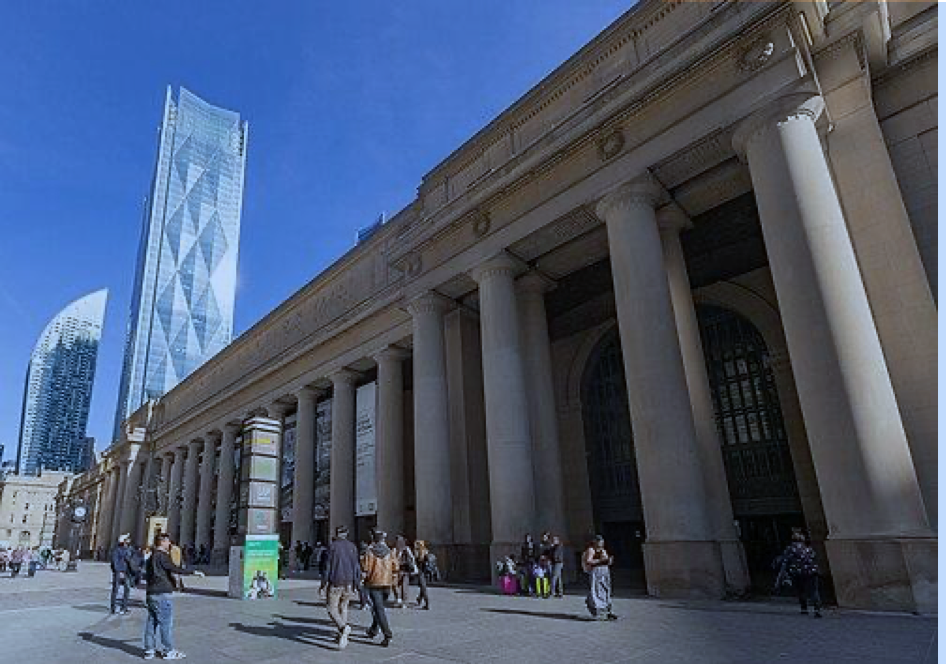
Toronto’s Union Station is the kind of building that makes you slow down even when you are late. Opened in 1927 after construction began during the First World War, it was designed in the Beaux-Arts manner by Ross and Macdonald, Hugh Jones, and Toronto architect John M. Lyle. Its Great Hall, with its soaring coffered ceiling, pale stone and disciplined symmetry, feels more like a civic palace than a transit interchange. Parks Canada designated it a National Historic Site in 1975, calling it Canada’s finest example of a Beaux-Arts railway station.
What makes Union Station worth an hour—or an afternoon—is that it remains intensely alive. It is Canada’s busiest multimodal passenger hub, linking GO Transit, VIA Rail, UP Express to Pearson Airport, and the TTC subway; its revitalization also turned it into a destination for shopping, dining and public events. I like arriving by subway, emerging into the Great Hall, and then walking south toward the waterfront, using the station as the starting point for a downtown loop.
● See: The Great Hall’s ceiling, columns and restored heritage details; look up before looking at departure boards.
● Eat and drink: Choose from the station’s many cafés and restaurants, then continue to nearby Front Street or the Distillery District.
● Photograph: The symmetrical Front Street façade in early morning, or the Great Hall when light fills the upper windows.
● Getting there: Union subway station is directly below; the station is also served by GO, VIA Rail and UP Express.
● Nearby: Walk east to the St. Lawrence Market area, or south to Harbourfront for lake views.
Waterfront Station, Vancouver, Canada
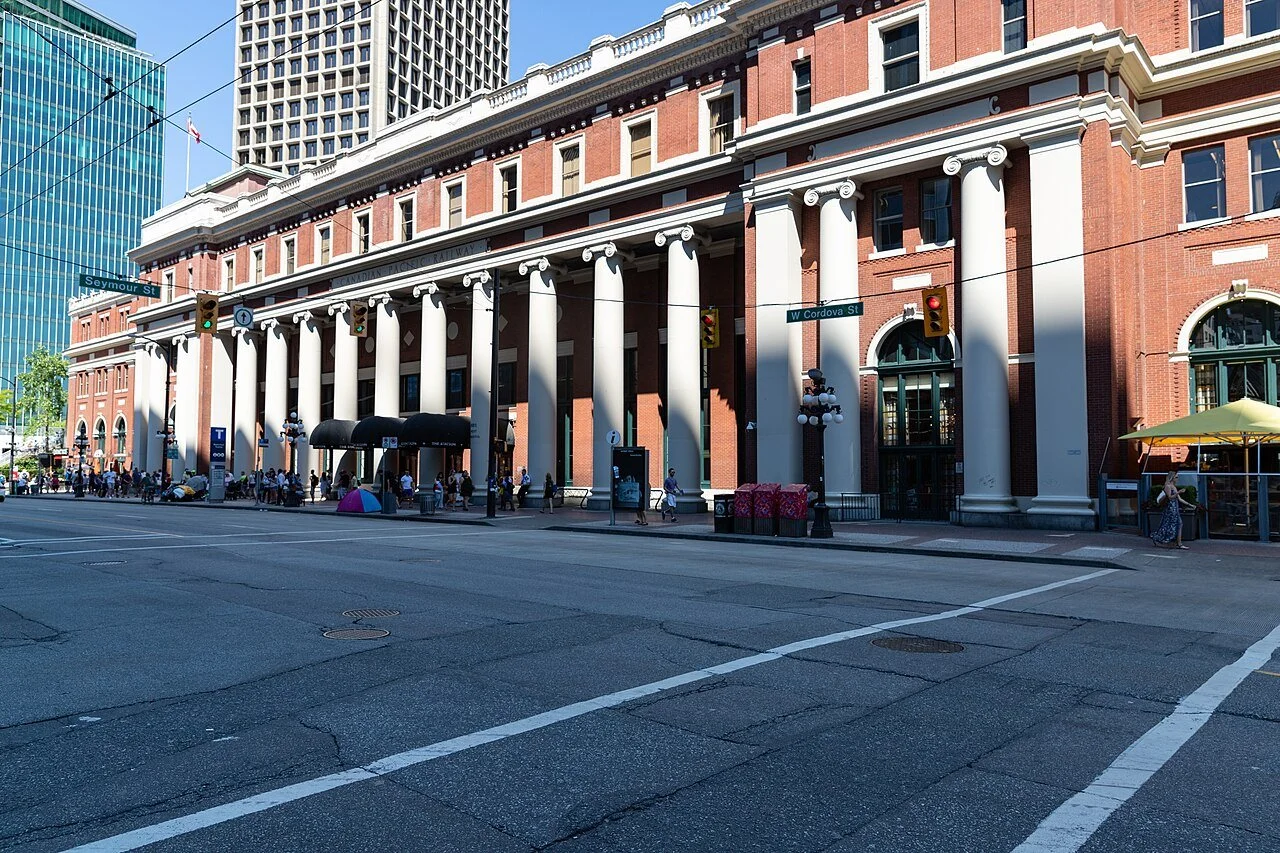
Waterfront Station is one of the most beautiful train stations in Canada precisely because it does not feel isolated from the city. Completed in 1914 as the Canadian Pacific Railway’s Vancouver terminus, it was designed by Montreal architects Barott, Blackader and Webster. Its red-brick façade, white Ionic columns and grand classical interiors speak to an era when a railway terminal was meant to announce a city’s ambitions.
Today, the building remains a working transit hub for SkyTrain, SeaBus, West Coast Express and buses, so it offers the best kind of heritage experience: history in daily use. I find it especially rewarding after a SeaBus crossing from North Vancouver. You step off the ferry, enter the old station, and immediately feel Vancouver’s unusual relationship between mountains, water, glass towers and early twentieth-century brick.
● See: The Ionic colonnade on Cordova Street and the station’s grand interior hall.
● Eat and drink: Rogue Kitchen & Wetbar is inside the station at 601 West Cordova Street; Steamworks Brewing is nearby for a more pub-like stop.burrardbulletin+2
● Photograph: Stand across Cordova Street for the full classical façade, then shoot the harbour from the nearby waterfront.
● Getting there: Take the Expo or Canada Line to Waterfront Station, or arrive by SeaBus from Lonsdale Quay.
● Best time: Late afternoon, when the light softens the red brick and the mountains begin to look theatrical.
Antwerpen-Centraal, Antwerp, Belgium
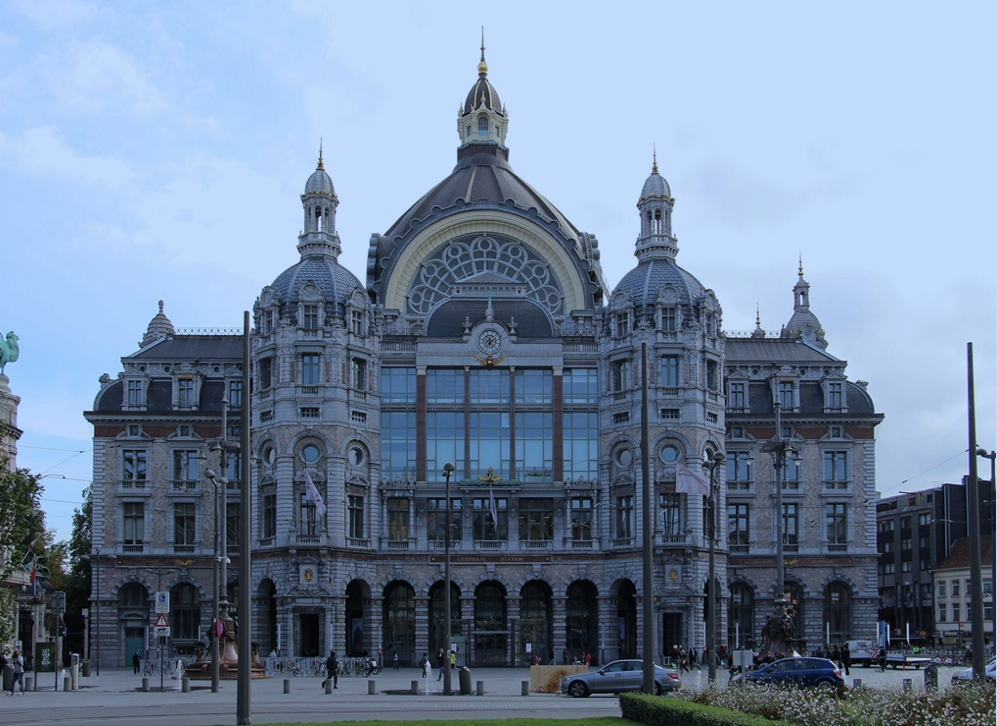
Antwerpen-Centraal is the station I would send any architecture-loving traveller to first. Built between 1895 and 1905 and designed by Louis Delacenserie, it mixes Neo-Baroque and Neo-Renaissance influences in a stone terminus crowned by a 75-metre dome. The contrast is part of its appeal: outside, an ornate civic monument; inside, a vast iron-and-glass train shed that still feels industrial and purposeful.
Locals call it the “Railway Cathedral,” and once you stand beneath that dome, the nickname makes sense. But Antwerpen-Centraal is not merely photogenic. It is a functioning main station with shops, cafés and waiting areas, and it sits beside Antwerp Zoo, making it easy to fold into a broader city itinerary. I would allow time simply to move between levels: the station’s vertical drama is as memorable as its façade.
● See: The domed waiting hall, marble detailing, gilded decoration and the iron-and-glass platform canopy designed by Clément Van Bogaert.
● Eat and drink: Cafés and shops operate within the station; the surrounding diamond district and central Antwerp are within walking distance.
● Photograph: The exterior from Koningin Astridplein, then the dome from directly beneath it.
● Getting there: The station is Antwerp’s main rail hub and is served by international, national and regional trains.
● Nearby: Antwerp Zoo is adjacent; the historic centre, Cathedral of Our Lady and Grote Markt are an easy walk away.
St Pancras International, London, England
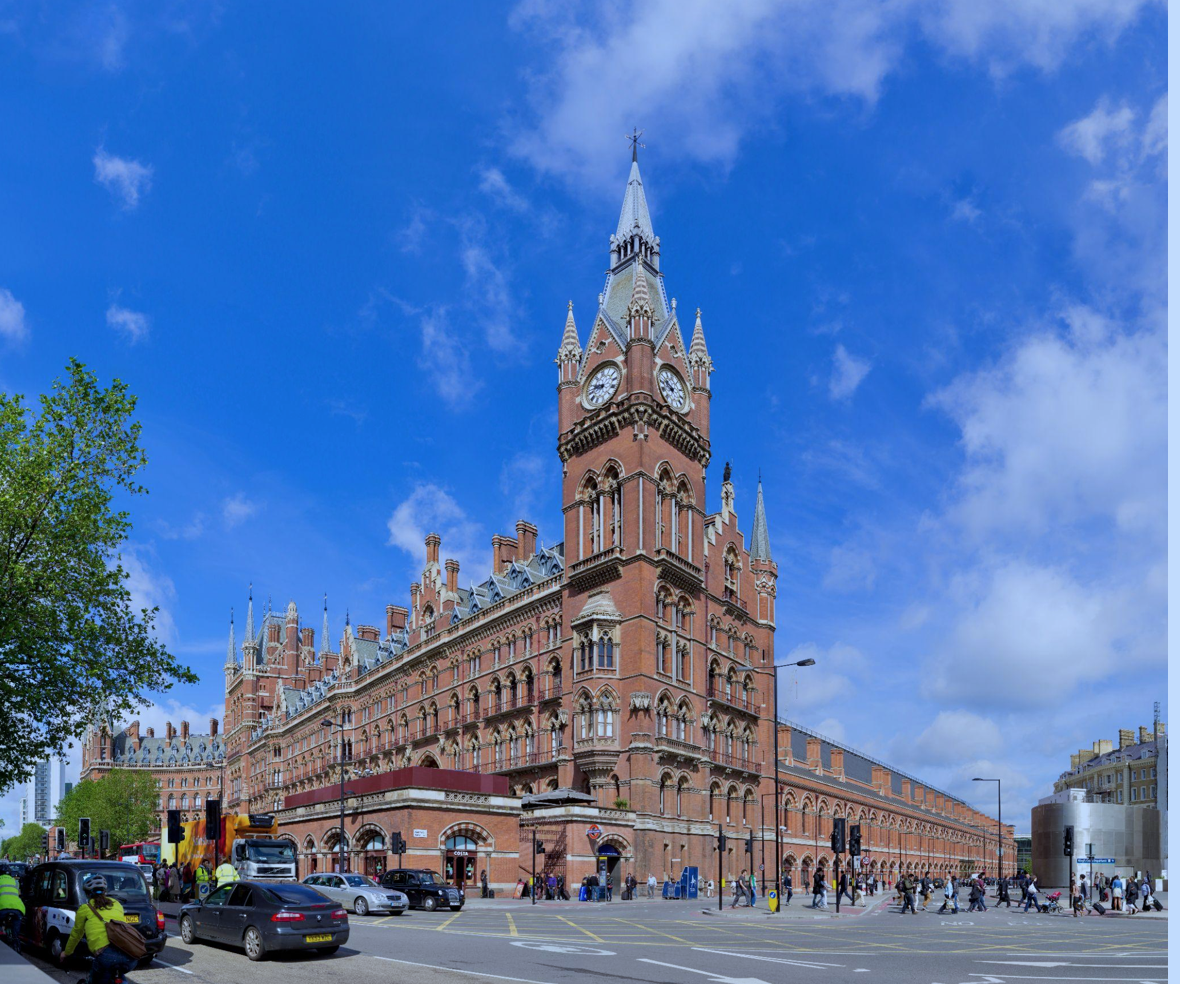
St Pancras is my favourite example of a railway station becoming a full urban destination. The station opened on 1 October 1868, designed by William Henry Barlow, while George Gilbert Scott designed the adjoining Midland Grand Hotel. Its soaring iron-and-glass train shed and red-brick Gothic façade make it one of London’s most dramatic Victorian interiors.
What I enjoy most is the collision of scales: Eurostar passengers heading to Paris and Brussels, commuters passing through, shoppers browsing, and visitors staring upward at the enormous roof. The station has bars, restaurants and shops on both levels, including The Betjeman Arms on the Grand Terrace. The bronze statue of poet John Betjeman—whose campaigning helped save the building—gives the space a welcome note of personality.
● See: Barlow’s train shed, the Gothic hotel façade, Paul Day’s The Meeting Place sculpture and the Betjeman statue.
● Eat and drink: The Betjeman Arms is inside the station; the surrounding King’s Cross area has numerous cafés and restaurants.
● Photograph: The upper concourse beneath the glass roof, especially in late afternoon; the exterior clock tower works well from Euston Road.
● Getting there: St Pancras International connects directly with King’s Cross and the London Underground; Eurostar services depart from the station.
● Stay nearby: The restored hotel within the station complex is the obvious splurge; King’s Cross has a wide range of hotels and cafés.
Make the Station Part of the Walk
A great station should not be something you rush through on the way to somewhere else. Treat these historic railway stations as anchors for a city walk: arrive without a timetable, spend twenty minutes looking up, have a coffee, then head into the surrounding streets. Whether you are seeking beautiful train stations in Canada or railway stations as tourist attractions abroad, the reward is the same: architecture, movement and city life gathered under one roof.
