
Beneath Transylvania’s Rolling Hills Lies a Day Trip That Defies Expectation
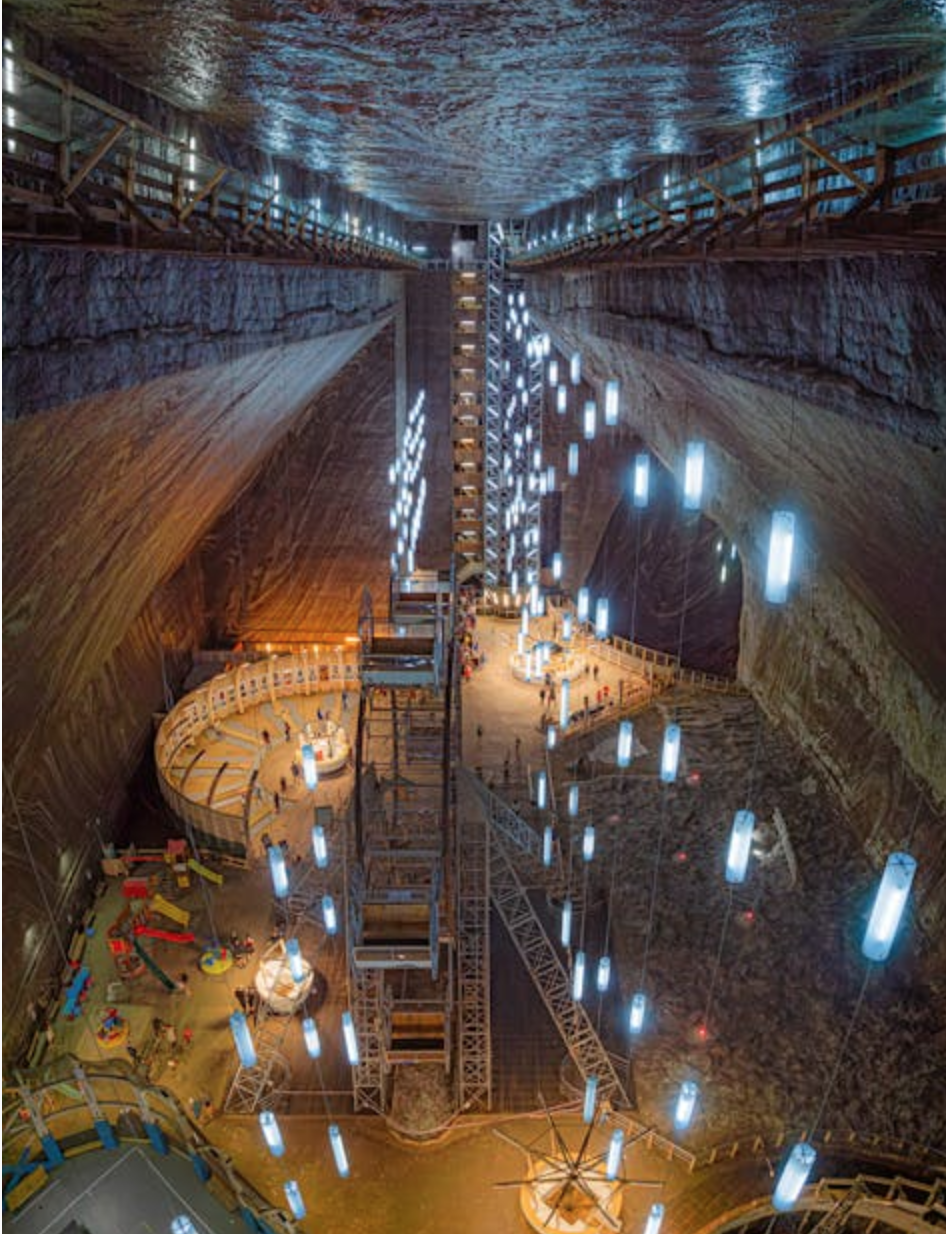
Imagine a Ferris wheel, a mini-golf course, and a bowling alley inside a cavernous salt chamber where the air is so pure it’s used for therapeutic breathing. There is even an underground lake where you can row boats in near-total silence beneath jagged salt stalactites. This isn’t a fever dream or a novelty attraction stitched together for social media—it’s Salina Turda, a former salt mine in northwestern Romania that has become one of Europe’s most unusual short-trip experiences.
For travellers who structure their downtime as a mix of immersive moments and lighter digital habits—reading on trains, listening to podcasts, or casually scrolling something familiar like Dudespin Casino—Salina Turda offers a sharp contrast. Once you descend below ground, the sense of constant input disappears. The space itself sets the pace.
Where it sits and why that matters
Salina Turda lies in the town of Turda, roughly a 40-minute drive from Cluj-Napoca, a regional hub with direct international flights. That proximity makes the mine an easy addition to a city-based itinerary. Many visitors arrive in the morning, spend several hours underground, and are back in Cluj by late afternoon—no overnight stay required.
This accessibility is key to Salina Turda’s appeal as a short trip. You’re not committing to a full travel day or rearranging your schedule. You’re stepping into something distinct, then stepping back out again.
A mine shaped by centuries, not spectacle
Salt has been extracted from this site since Roman times, but the sections open to visitors today mostly date to the 18th and 19th centuries. You can still see the horizontal extraction marks carved into the walls—physical timestamps left by generations of miners.
The mine closed in 1932, long before tourism was part of the plan. During the Second World War, it served as a bomb shelter and storage space. Its transformation into a public attraction began decades later, with careful attention paid to preserving the raw geometry of the chambers rather than smoothing them into something theatrical.
That decision gives Salina Turda its character. The space feels honest. Vast, slightly austere, and quietly impressive.
The descent changes everything
Entering Salina Turda is a gradual process. You don’t step straight into the spectacle. Instead, you move downward through tunnels and staircases, the temperature dropping and the air becoming noticeably drier and cleaner.
By the time you reach the Rudolf Mine—the largest chamber—the scale resets your expectations. The walls rise more than 40 metres, their salt surfaces catching light in muted greys and whites. Suspended in the centre is the Ferris wheel, turning slowly, its movement almost meditative rather than playful.
It’s here that visitors tend to slow down. Voices soften. People look up more than they look at their phones.
Leisure placed deliberately, not loudly
Salina Turda’s recreational features are intentionally restrained. The mini-golf course is compact. The bowling lanes are few. Table tennis tables sit off to the side rather than dominating the space.
What makes these activities memorable isn’t their complexity, but their setting. Rolling a bowling ball underground, hearing it echo briefly before the sound dissolves into the chamber, feels entirely different than doing the same thing on the surface.
This kind of contextual leisure mirrors how many people now approach entertainment more broadly. A quick session on Dudespin Casino, for example, fits into daily life precisely because it’s bounded and familiar. Salina Turda applies that same logic physically: small activities framed by an extraordinary environment.
The lake at the bottom of the mine
The Terezia Mine is the deepest section open to visitors and arguably the most striking. Its bell-shaped chamber narrows as it rises, drawing the eye upward while a circular lake sits at the base.
Wooden rowboats glide slowly across the water. The lighting is subdued, and the acoustics are unusual—oars splash softly, voices carry upward, and then fade. There’s no rush here. Boats move at walking pace. People linger.
This is often where visitors stop trying to document the experience and simply sit.
Why the air is part of the attraction
The mine’s air quality isn’t incidental. Salt mines across Eastern Europe have long been associated with halotherapy, and Salina Turda continues that tradition. The stable temperature and mineral-rich air draw visitors who simply want to breathe differently for a while.
Benches and rest areas are scattered throughout the chambers. You’re not instructed to do anything specific. The space allows for stillness without ceremony.
That openness is part of what makes the experience restorative rather than prescriptive.
A clear contrast to surface-level entertainment
On the surface, modern leisure often means switching rapidly between options—news, messages, streaming, casual gaming, or a familiar online environment like Dudespin Casino. Underground, those impulses lose their urgency.
There’s nothing to optimize. No sequence to follow. You move, stop, look, and move again. Time stretches slightly, not because you’re busy, but because you’re not.
The contrast isn’t judgmental; it’s revealing. One mode fills gaps. The other reshapes attention.
Practical details worth knowing
Salina Turda is open year-round, with a constant temperature of around 10–12°C, making a light jacket useful even in summer. The pathways are well maintained, but there are stairs, so comfortable shoes matter.
Despite its popularity, the mine rarely feels crowded due to its sheer volume. Even during peak periods, visitors disperse naturally across the chambers.
The lasting impression
Salina Turda works because it knows exactly what it is: not a thrill attraction, not a museum, not a spa. It’s a contained world that asks visitors to slow down without insisting they change who they are.
Whether your usual downtime involves walking historic streets, listening to music, or briefly checking Dudespin Casino, this subterranean fair offers something complementary—a pause that feels earned, specific, and quietly memorable.
You come back to the surface unchanged, but recalibrated. And for a short trip, that’s more than enough.
