
The Thrift Store Tourist: Salamanca Market
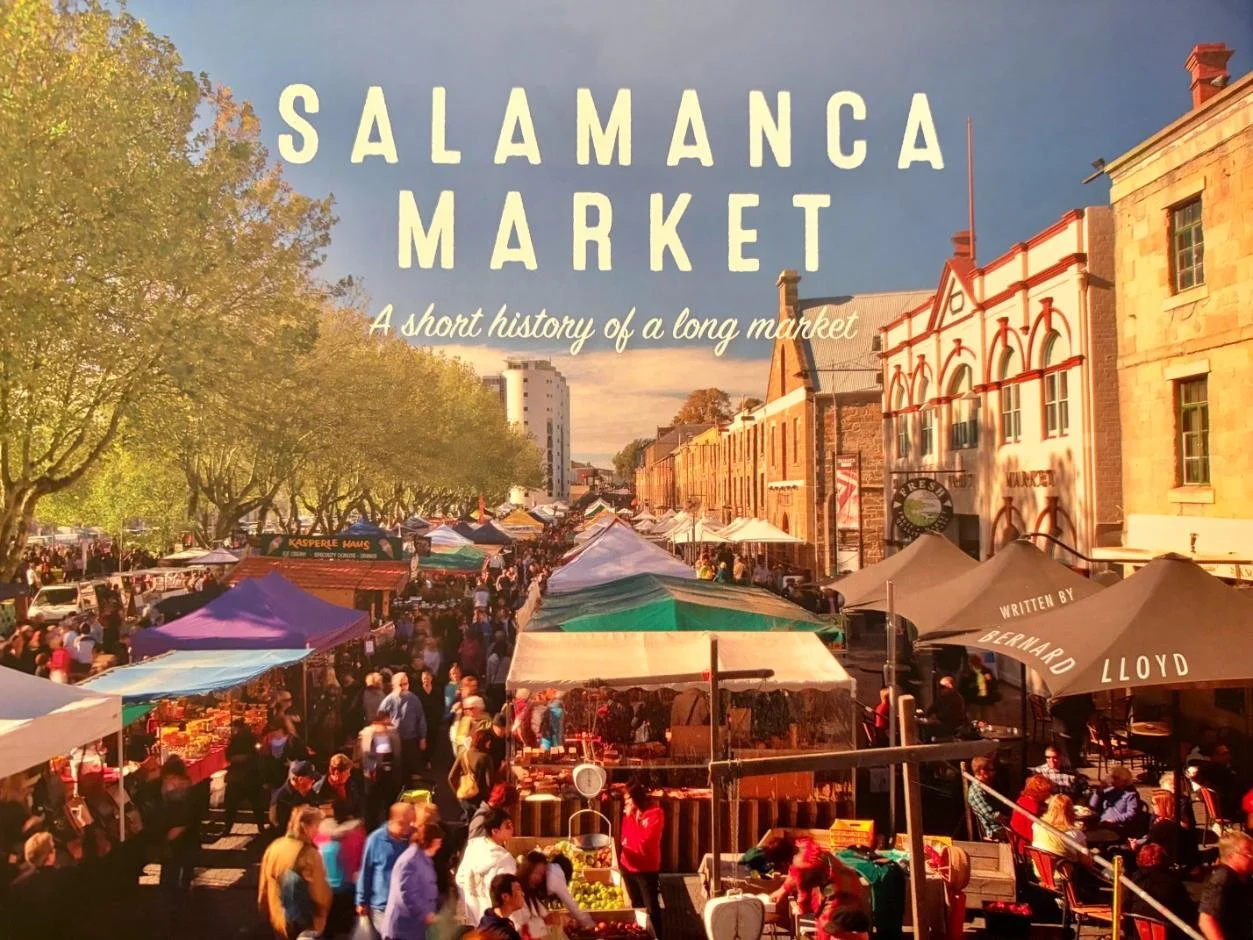
Recently, when browsing the used books at my favourite thrift store in Calgary (WINs in the Beltline), I happened upon an interesting coffee table book about the Salamanca Market. Intrigued with the name (sounded African), I grabbed it for 33 cents (books are 3 for a dollar) to read later.
A few days later, I started leafing through it. It turns out the market is in downtown Hobart, Tasmania and it was more a history book than a coffee table book! I wondered how it got to Calgary. I doubt I will ever get to Hobart so I thought this could be a fun hour or two of reading.
The book was published in 2014, by the City of Hobart, so although it is promotional piece I found it to be less touristy and more like an illustrated history book. A quick internet check found that Salamanca Market is still thriving today.
Everyday Tourist Tip: One of the first things I do when researching a new city to visit is to find out if they have a weekly farmers’ or flea market. Markets are a great way to mingle with locals and experience the local vibe.
The name “Salamanca” refers to the “battle of Salamanca” fought in Spain on July 22, 1812, during the Peninsular War (1808-14). The battle defied British Lieutenant-General Arthur Wellesley, Earl of Wellington, whose reputation was as a defensive general and shattered French dominance on the Iberian Peninsula during the Napoleonic wars.
Hobart was founded as a British penal colony in 1804 and subsequently became a major whaling post and capital city of the Australian state of Tasmania. It was common practice for British colonists to name neighbourhoods, streets and buildings after places from their homeland as a means of warding off homesickness.
Lesson learned: Neighbourhood, street and building names are a great way to preserve a city’s heritage. Too often these days, neighbourhood, street and building names are meaningless.
Salamanca Market Story
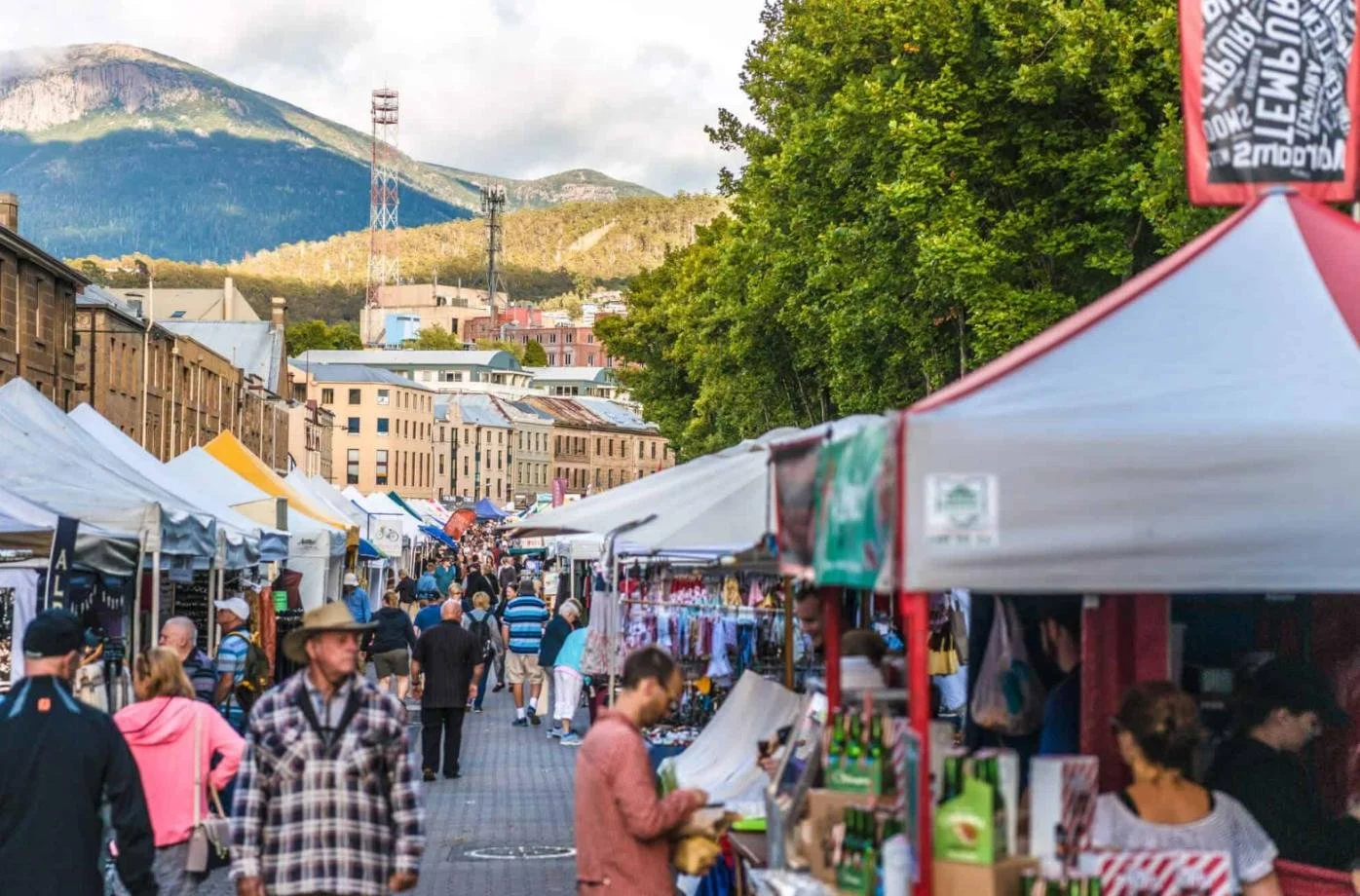
Turns out the market isn’t that old. It first opened in June 1971 as a trial market with just six stalls along Salamanca Place, a street of historic sandstone warehouses along Hobart’s waterfront. It slowly became a popular tourist spot with the buildings repurposed as restaurants, galleries, boutiques and offices. The market evolved from four weeks before Christmas until Easter (Hobarts summer) until 1975 when a winter market was introduced. By the 1980s, it grew to 150 stalls and just kept growing from there.
Today, the market operates every Saturday (from 8:30 to 3 pm) year-round, with 300+ stalls attracting 40,000 visitors in the summer and 25,000 it the winter.
The market has been the catalyst to create a vibrant downtown attraction on Saturdays, with the sounds of street performers, musicians and vendors calling out to visitors to buy their product. It is a mix of crafts, clothing, farmers’ produce and music.
In the 1970s, Hobart’s city centre was a dead zone, as selling was taboo on Saturdays and Sundays. However, in 1971, Alderman John Clemente convinced Council to create the market as a community event. I expect it also helped that the National Council of Women of Tasmania were keen supporters of the market from the onset with four of its affiliates - Girl Guides, The Child Health Association, Women’s International League for Peace and Freedom Foundation and Home Economic Association.
Lesson learned: Creating a great city requires leaders who can work around the existing rules and mores.
Salamanca Market Fun Stories:
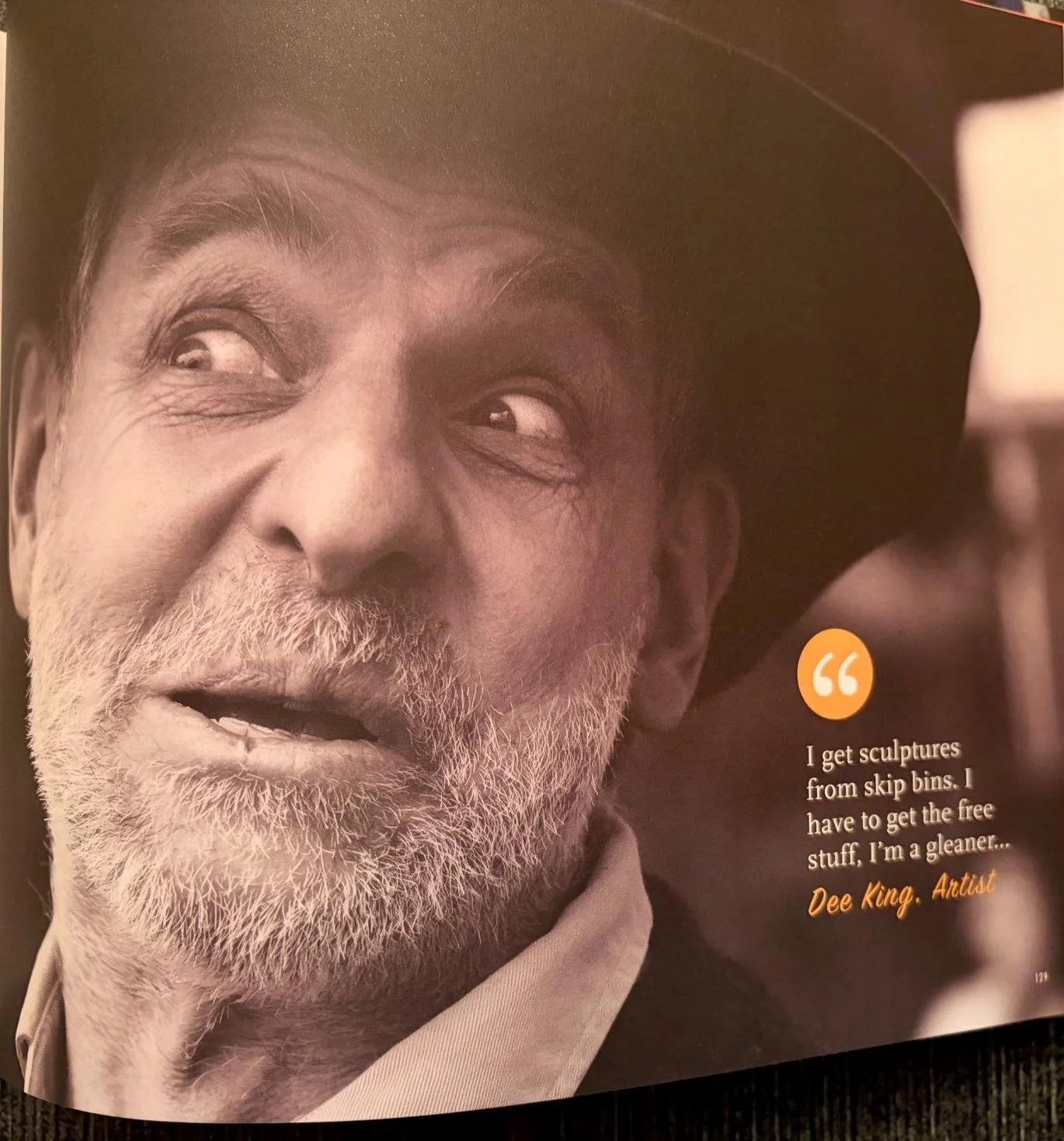
The book is full of fun stories and background information. There is an entire chapter of about the various stallholders’ backgrounds from the grime of a blacksmith to plant breeder and even a recipe on how to make Apple and Dukkha Tarte Tatin.
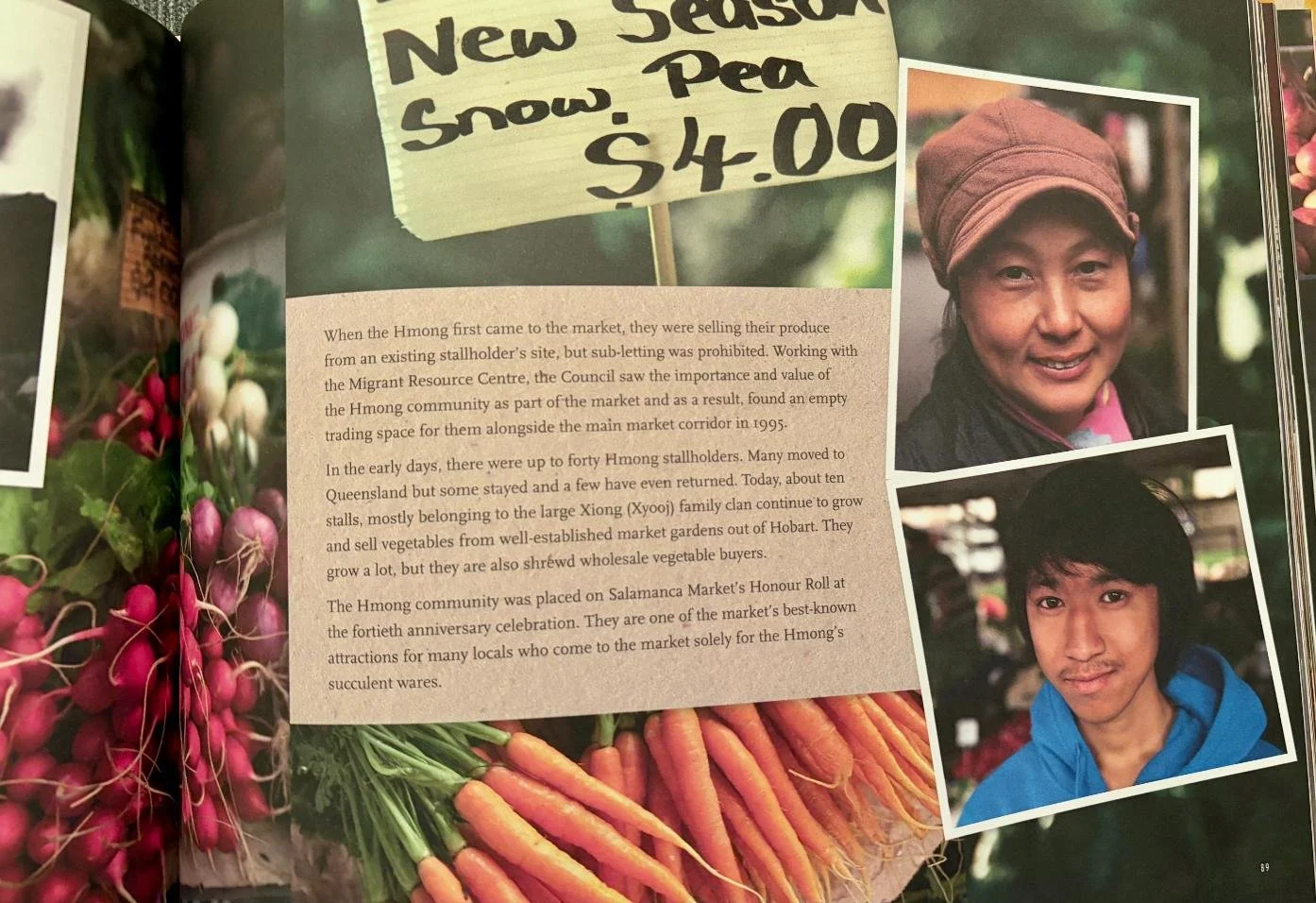
I loved the story about Hmong refugees from China who settled near Hobart in the late 1980s and soon started coming to the market to sell excess vegetables from their backyards and how their brightly embroidered cloths added colour and charm to the market. Originally selling from an existing stallholder’s site, (which was illegal), a permanent empty trading space was for them in 1995. Today they one of the market’s most popular stall holders.
Buskers are big part of the success of the market. To quote the 1971 Salamanca Market Feasibility Report, “a properly balanced market is reinforced by auxiliary attractions such as band concerts, puppet theatre, exhibitions and pageantry.”
In 1987, Vic Garth at age 74 was appointed the Town Crier. And, for the next 18 years (he died in 2005 at the age of 92) he was a common site in Hobart, not only greeting people at the market but disembarking cruise ship passengers and leading the Christmas Parade.
There is even a Salamanca Blend tea, thanks to stallholder Samanta Brown, who combined green tea with mango, peach and chrysanthemum flavours to create this unique tea blend. The packet says, “it is as colorful and enjoyable as the market itself.”
Market Day
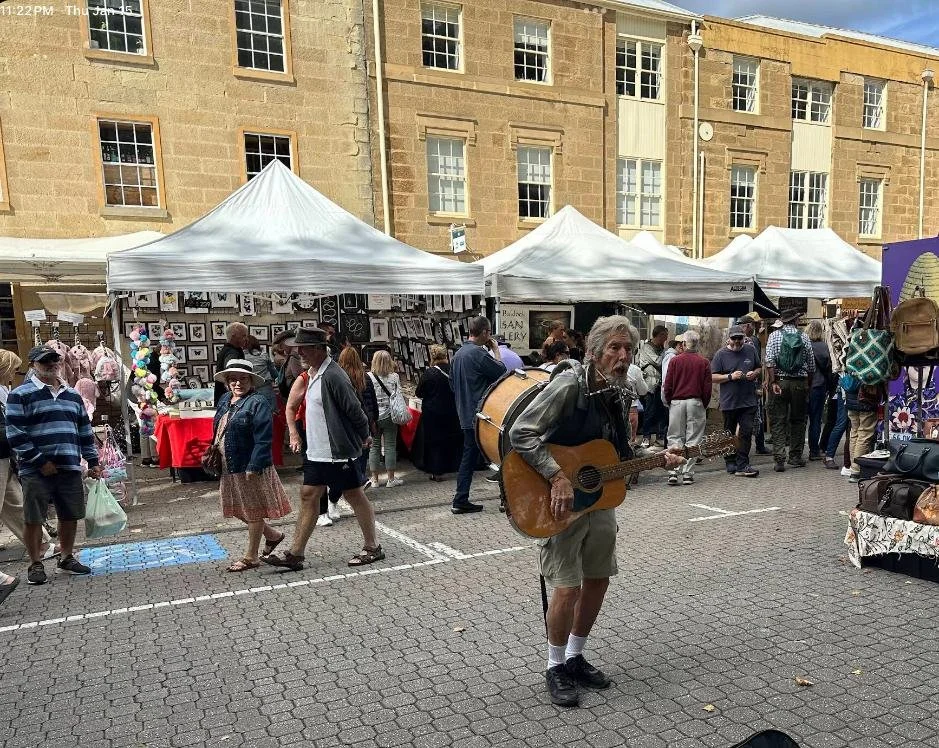
The book’s Market Day chapter is a particularly fun read. It starts with vendors arriving at 5 am but can’t start setting up before 5:30 am. And how setting up on Saturday morning is difficult due to the antics of blurry-eyed night clubbers who interfere with set up by jumping on tables, knocking down roadblocks and in one case, coming down the street cracking a whip.
Local Ian Cox became the “market gofer” after having a bad motorcycle accident around 1977 that he never fully recovered from. He would come every week and help stall holders, by watching their stall while they went for a coffee or washroom break. There is a bench in his honour on the “lawns” (aka park) next to the market.
The world “stall” has an archaic root in “sta,” meaning to stand. A stall doesn’t have a door, walls or roof, creating an openness between the buyer and seller. Stall owner Lorretta Olsen never had a roof until her husband started helping her (prior to that if it rained, she just wore a plastic sheet). Today, the stall roofs create a colourful kaleidoscope.
In 1997, City Council did something rare among Australian markets – it granted stallholders the right to transfer their licence to trade at the market to any buyer of their business. The current price is about $50,000.
Salamanca Place
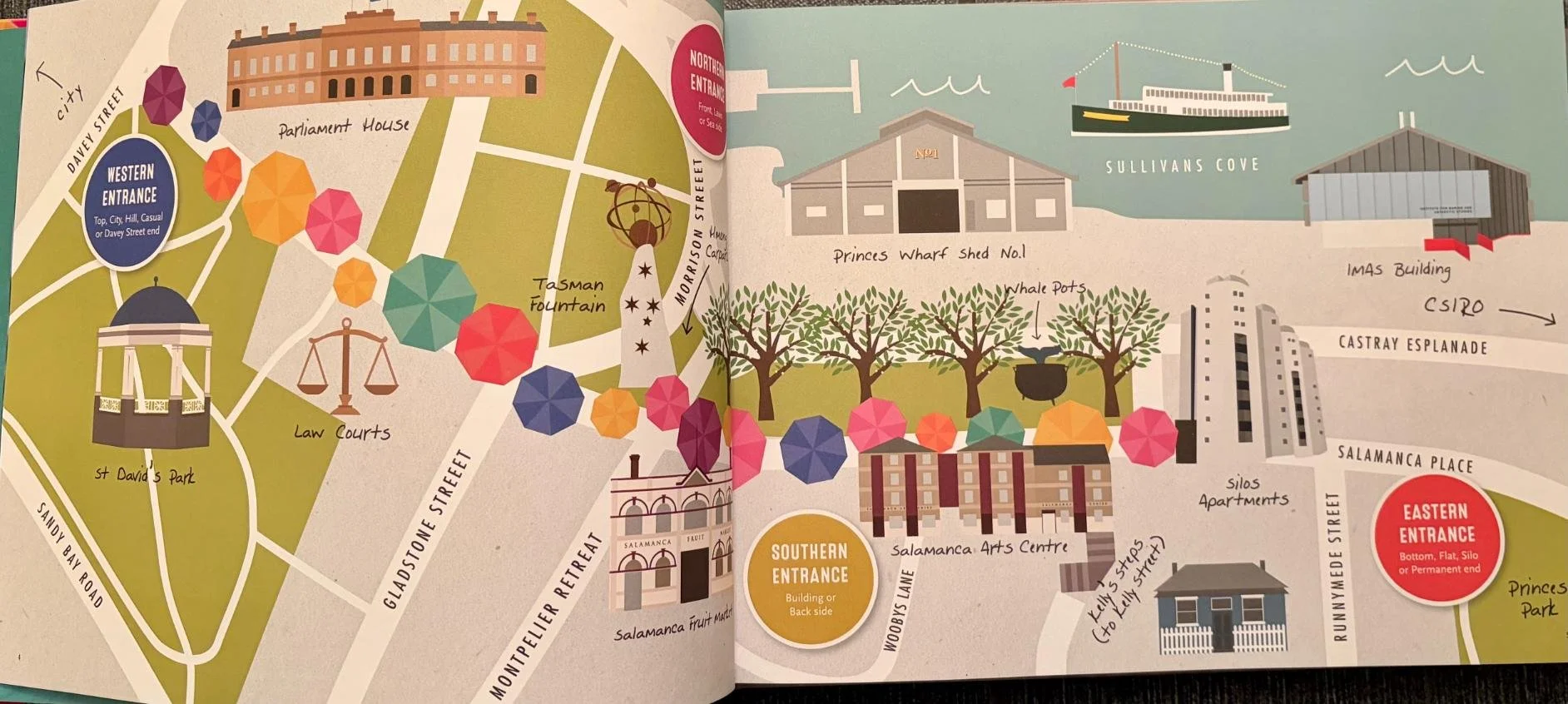
Hobart’s Salamanca Place is name of the overall neighbourhood where the market is located. It stretches from Davey St down to the waterfront and includes St David’s Park (a former cemetery), Princes Wharf and the warehouses which were constructed in the early 1830s.
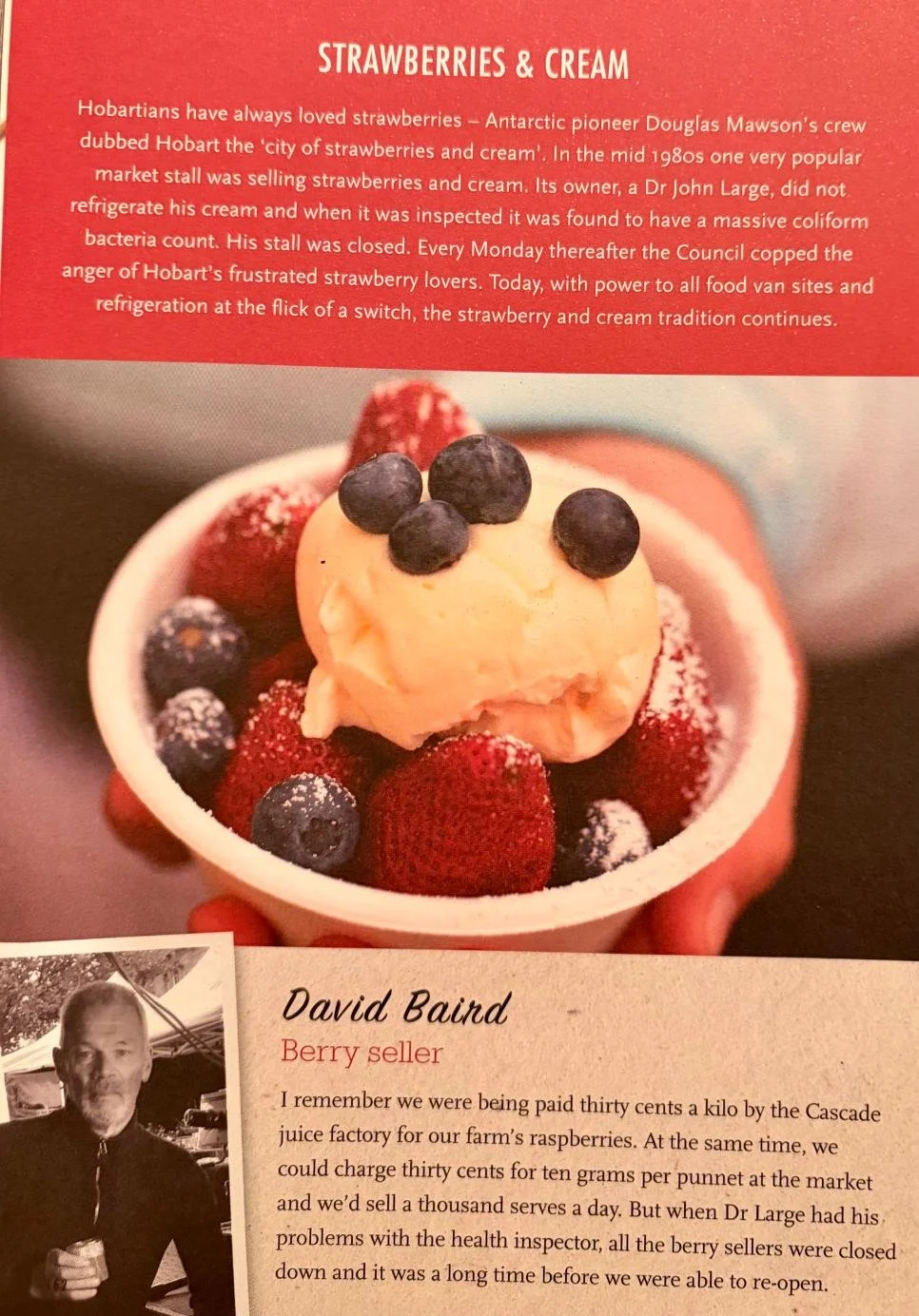
It turns out Hobart has a long history of markets along the waterfront next to the shores the Sullivans Cove. There was an indoor market back in 1850s that struggled for a few decades before being destroyed in fire in 1906. The area had a dockside fish market for 150+ years.
Lesson learned: If at first you don’t succeed, try, try again. Cities must continuously adapt to changing technology, markets and economics.
Plane Trees
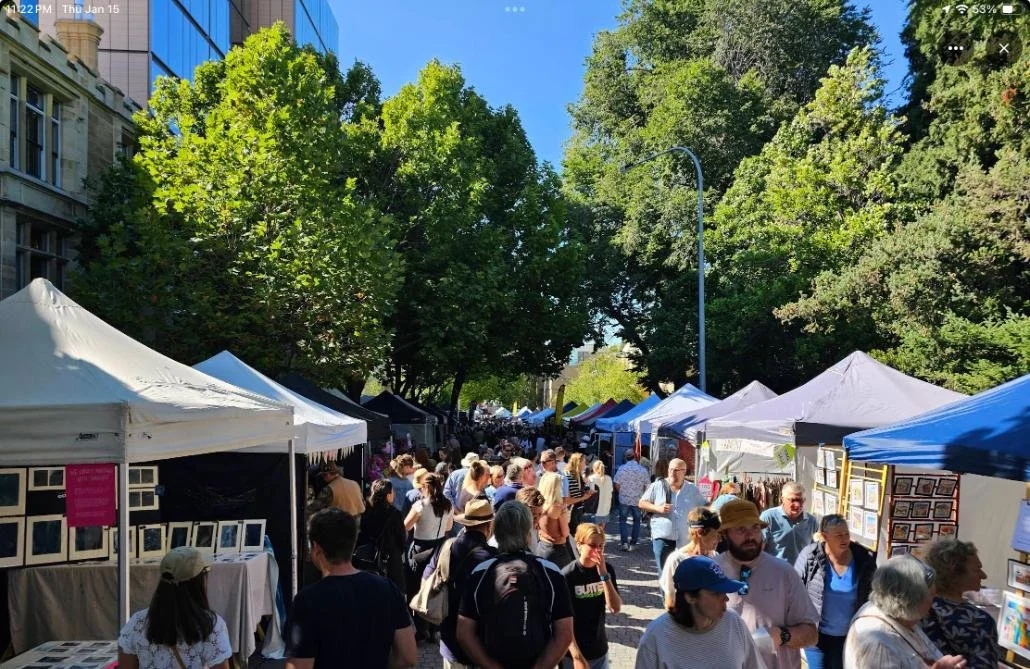
The neighbourhood’s streets and parks are lined with “plane” trees (not native to Hobart) common worldwide in cities with temperate climates. The first trees planted in Hobart were hybridised in Spain as a cross between the oriental and American plane tree early in the 19th century. They help make the neighbourhood pedestrian-friendly being leafless in the winter allowing the sun to warm the street and create a welcomed shade canopy when fully leafed out in the hot summer. They are known for being fast growing when young and have a life span of 300+ years.
Lesson learned: Trees are a great way to create a more pedestrian-friendly urban experience.
Last Word
The book’s author, Bernard Lloyd, tells the story of how he moved to Hobart knowing no one, so he often went to the market where the stallholders were always up for a chat and soon became his first friends. Twenty years later, he bought Ron Murray’s plant stall and he became a vendor. He thinks the Salamanca Market is Hobart’s quintessential experience. While stallholder Nick Haddow thinks “Salamanca Market is almost like improv theatre to us.”
I wish Calgary’s downtown had a weekend market to attract Calgarians and tourists alike to come downtown for some “improv theatre.”
