
Bilbao in a Day: The Guggenheim, Pintxos and the Old Town
A day in Bilbao sorts itself out around the Guggenheim. It's why most people come, and it's worth more time than it usually gets. Everything else you'd want is along the same stretch of river. From the museum you can follow the water into the old town without a map, and the pintxos bars begin roughly where the old streets do.
One day covers it, funicular included if the sky holds.
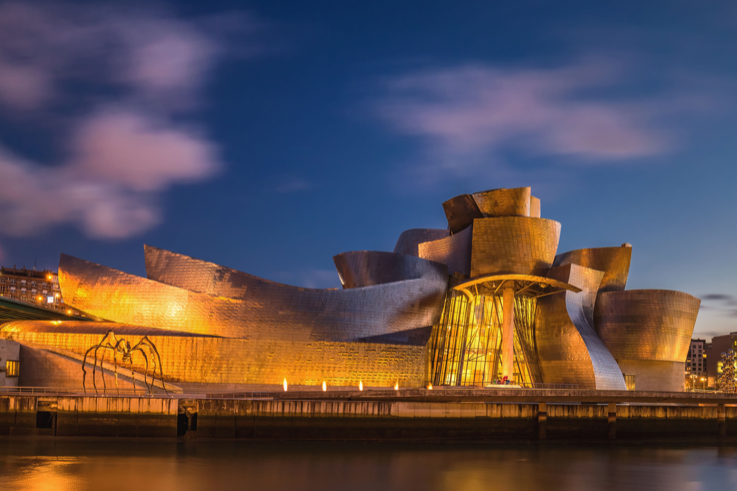
Start with the Guggenheim
Frank Gehry's building is the main event, and I'd give the first half hour to the outside of it before going anywhere near a ticket desk. The titanium catches whatever light is going, so it looks like a different building in sun and in drizzle. Do the full circuit. The river side is the showy one, all curves and overhangs. The city side is lower and quieter and fits in better with the streets behind it.
Jeff Koons's Puppy stands at the entrance, a huge terrier covered in flowering plants, and the planting changes through the year. It's easier to look at properly from twenty metres back, which is where I'd stand, because there's usually a queue of people waiting to be photographed with it. And yes, it looks like a lot of fuss over a shrub. Then again, it is a giant dog made of flowers. Of course people queue.
Inside, the atrium does most of the work. It rises the full height of the building with walkways crossing it, and it's the point where the outside shape starts to make sense. The galleries vary a lot. Some are conventional rooms, and at least one is enormous, built for work at a scale most museums can't handle. That's what the collection leans into, so expect big installations more than rooms of small paintings.
The holdings are modern and contemporary, and the temporary exhibitions take up a fair share of any visit, so check what's on before you come. Large contemporary work isn't to everybody's taste and it isn't always to mine. If a show doesn't appeal, the building still justifies the entry on its own.
Two hours is a comfortable visit, and an hour and a bit does it if you're mainly there for the building. Booking online in advance saves standing about, and mornings are usually calmer than the middle of the afternoon. Whatever you do, leave a bit of time for the terraces outside afterwards, because the outside looks different once you've been in.
The riverside walk
Come out of the museum and the river is right there. There are paved walkways on both banks and footbridges every few hundred metres. It's flat, easy walking, and it's the nicest way to get from the museum towards the old town. Allow about half an hour at a slow pace.
This was a working port for a long time, with shipyards and warehouses along the water and very little reason for anyone to stroll here. The regeneration cleared most of that and turned the banks into public space, and the museum was the piece that made the rest of it possible. You can still read the industrial past in the width of the river and the amount of ground it takes up.
If you have an hour spare, the Artxanda funicular runs up the hillside on the north side to a viewpoint over the city. The ride is short. From the top you can see how tightly Bilbao is packed into its valley. I'd go up in the late afternoon if the timing works, when the light on the hills is kinder.
The Casco Viejo and a pintxos crawl
Cross the river and you're in the Casco Viejo, the old town, built around the Seven Streets that formed the original medieval core. It's compact and mostly pedestrian, with tall narrow buildings and shops that have been doing the same thing for decades. Wandering is the point, and you'll come out somewhere useful whichever way you turn.
The Ribera market sits at the edge of it by the water, a big covered hall of fish and produce stalls with somewhere to eat at one end. Decent first stop if you arrive hungry, though the bars behind it are where most of the evening happens.
Pintxos next, and I'd start on Plaza Nueva, the arcaded square in the old town that has bars all the way round it. Café Bar Bilbao, on the square itself, is a good first stop. They're small plates, usually served on bread and laid out along the bar, and you take one or two with a drink before moving on to the next place. Settling into one bar for a whole evening rather misses the point, and the moving about is half the pleasure of it.
A couple of things help. Much of what's on the counter is cold, and the better food is often cooked to order from a board behind the bar, so ask what's hot. The classic one to begin with is a gilda: an anchovy, an olive and a pickled pepper on a cocktail stick. Portions are small by design, so four or five stops makes a normal evening and not a heroic one. Drinks come in small measures too. A zurito is a short beer, txakoli is the local white, and the small measures are what make moving on so easy. You pay per pintxo and settle up at each bar before you leave, and it's normal to stand.
Practical notes for a day trip
The centre is walkable from end to end, and the metro handles the longer hops if your feet give up. A Barik card is worth picking up if you're moving about at all, because the one card covers the metro, the tram and the Artxanda funicular. Rain is common enough that a jacket tends to be more use than an umbrella. Basque eating hours run late as well, so a pintxos bar at half six will be quiet, and that's normal.
Bags are the one thing worth sorting before you arrive. Neither Bilbao-Abando nor Bilbao-Concordia runs a left-luggage office these days, and the airport terminal has none either, so day visitors book storage at shops and hotels around the centre instead. Arranging left luggage in Bilbao ahead of the trip is quick, and a few of the storage spots stay open late.
