
There is no way one can miss out on the City of Arts and Sciences in Valencia. Buildings in white are towering over the vivid blue pools of water. Immense arched structures are stretching across the skyline. Everywhere you turn your eyes, you will find yourself staring at something right out of a sci-fi movie!
While most of the people visit the city for Oceanogràfic, the Science Museum, or the Hemisfèric, all of which are definitely worth visiting, there is so much more that you can explore without having to spend the entire day inside.
What you need to do is relax, take your time and not rush from one ticket counter to another. Instead, just walk around the complex, take a glance upwards, cross the bridges and explore the space between the well-known buildings.
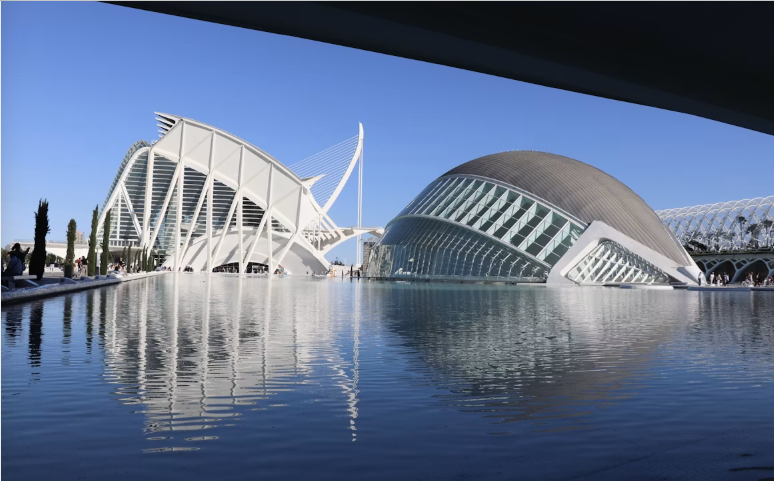
Glass curves of L’Hemisfèric and the ribbed façade of the Science Museum with the Assut de l’Or bridge, mirrored in the serene blue pools of Valencia’s City of Arts and Sciences. Photo credit: Thomas K
Start With the Gaps Between the Well-Known Structures
The City of Arts and Sciences is almost like a mini-futuristic district. The structures are connected by lengthy pathways, pools, gardens, bridges, and open squares. The entire district is located in the eastern part of Valencia's former riverbed, which turned into a large park cutting through the city.
This makes it particularly exciting to visit the place when interested in architecture, urban design, photography, and tourism. Some students who are visiting seek online essay writers when they need help with their academic assignments in order to gain extra time for wandering the city, its buildings, or doing work on a travel project. According to Annie Lambert, an education expert from the essay writing service EssayPro, such places become comprehensible only after spending some time observing them in practice.
Approach the Hemisfèric structure first, but don't enter it right away. Instead, start walking along its long reflecting pool. The structure will resemble an enormous eye from one angle. If you walk a bit further, you'll be able to see the reflection that completes the shape.
Take Your Time in L’Umbracle, Don’t Just Pass By It
It is very easy to overlook the importance of L’Umbracle while you are hurrying to the museums. This is a bad idea.
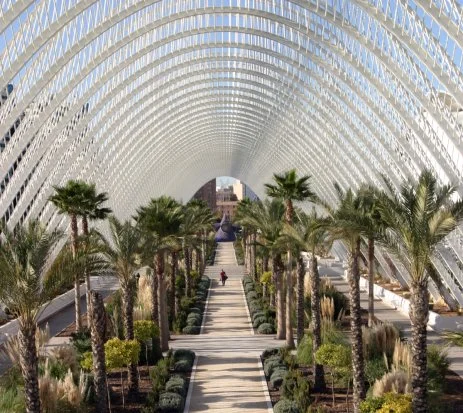
L'Umbracle is a huge garden located underneath a huge array of white arches. Its total area is more than 14,000 square meters, and it provides visitors with a beautiful panoramic view of the surrounding lakes, walks, and architectural structures. Also, it includes a mix of plants and outdoor sculptures.
Take your time and enjoy the changing shapes of arches as you stroll through it. Palm trees and Mediterranean vegetation help you to relax after the hard white lines of the architectural structures.
Also, there is an art walk in L’Umbracle. You don’t need to know anything about art to appreciate it. Consider it to be an outdoor exhibition. Stop by one of the sculptures, take a walk around it and notice the changes that happen in the background of the structure.
L’Umbracle is especially impressive later in the day when the sun is lower and the temperature is more comfortable.
Cross the Assut de l'Or Bridge
Most likely, you'll notice the Assut de l'Or Bridge before considering crossing it. The white mast of the bridge dominates the complex and is a landmark of the modern skyline of Valencia.
The bridge crosses the former Turia riverbed from the Science Museum to the Ágora site. There is a pedestrian path connecting the left and right parts of the Turia Garden.
When standing on the bridge, you will have another look at the complex. The buildings seem to be integrated into one whole design.
And here you start to realize the scale of the complex. On the ground, some buildings obscure others. From a height, you see pools, gardens, walkways, roofs of museums, and the neighboring areas at once.
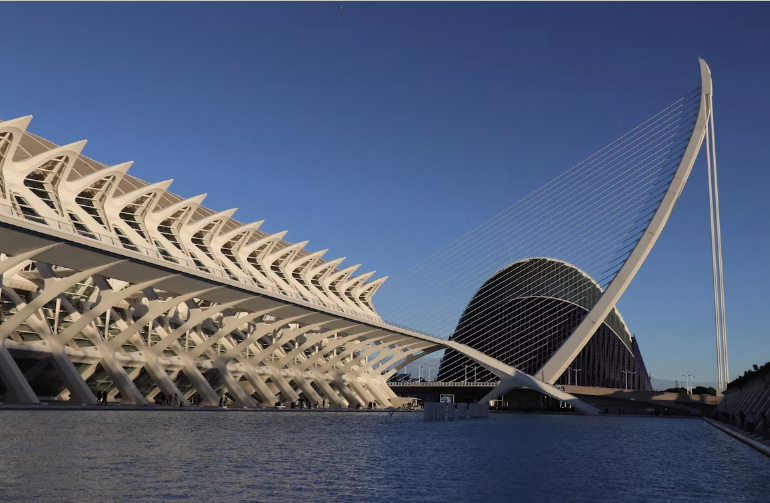
Golden hour over Valencia’s City of Arts and Sciences: the ribbed façade of the Museu de les Ciències, the harp-like Assut de l’Or bridge and the domed L’Hemisfèric aligned above the reflecting pools under a deep blue sky. Photo credit: Thomas K
Step Inside the Ágora of CaixaForum València
The large blue building beside the bridge was once mainly known as the Ágora. Today, it is also home to CaixaForum València.
This is relevant to know since a lot of tourists often simply walk past the building in order to reach the aquarium.
However, the interior is drastically different from the white architectural design that surrounds the exterior. CaixaForum features exhibition halls, an auditorium, family areas, workshops, cultural events, and unique art installations. The interior design project brought additional shapes and spaces to the existing Santiago Calatrava building.
In 2026, the center still holds exhibitions, lectures, concerts, workshops, and other family activities. It operates all year round, even though the exhibitions vary depending on the time.
Even if you do not visit the exhibitions, appreciate the building as it is. You will definitely like the contrast between the cultural center and one of the most peculiar modern buildings in Valencia.
Go Through Turia Garden After Museum
One of the biggest errors is exiting through the nearest road immediately after the end of your visit to the museum.
Instead, head through Turia Garden.
The dried-up riverbed turned into a green route that goes for more than nine kilometers through Valencia. You will see cyclists, runners, playgrounds, sports facilities, palm trees, fountains, and people just sitting under the trees.
The difference is amazing. In one moment, you find yourself surrounded by enormous futuristic buildings. And in just a couple of minutes, you are already walking through the greenery.
If you have additional time, go towards Gulliver Park. This enormous playground is constructed on the image of the giant Gulliver lying on the ground. It is mostly for children, but its unusual architecture makes it worthwhile even without the little ones.
And you can also rent a bicycle to go through the garden to the city center.
Find the Perfect Photographing Angles
Here you won’t need professional gear. A cell phone is more than enough!
Here are some easy photography tips:
Shoot the Hemisfèric along with its reflection.
Position yourself under the L’Umbracle arcades and shoot along those repetitive lines.
Use the pools to create reflections of the Science Museum.
Cross the Assut de l’Or Bridge to get an elevated view.
Come at the time of sunset and shoot the buildings with warmer light.
Stay till the early evening when the complex lights up.
Do not photograph all your pictures from the same famous place. Move ten or twenty meters to the side. Lower yourself. Shoot through an arcade. Put a palm tree in the foreground.
The architectural composition transforms rapidly when you walk around it.
