
Prague’s Old Town: Castles, Bridges and Cobblestones
Prague does not ease visitors in. Step off Charles Bridge into Old Town Square and the city shows its full hand at once: Gothic spires, Baroque façades, a 600-year-old clock, and cobblestones polished smooth by a thousand years of footsteps. For a city this dense with history, the remarkable thing is how walkable it all is. Nearly everything worth seeing in Prague’s historic core sits within a 20-minute stroll, which makes Old Town one of Europe’s best destinations for travellers who’d rather wander than ride. Founded in the 13th century and preserved almost intact through wars, floods and political upheaval, this is one of the few European city centres where the medieval street plan, the church towers, and the cobblestones underfoot are all still original. This article walks through the district the way a first-time visitor actually experiences it: the bridge, the square and its famous clock, the castle on the hill, the Jewish Quarter, and the quiet lanes connecting them, along with the practical details that make a single day here go smoothly.
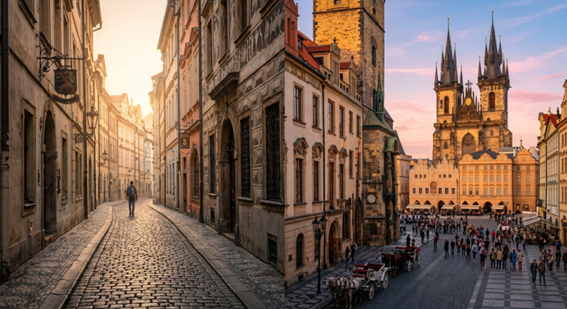
Exploring Prague's Old Town
A City Built for Walking. Prague’s Old Town, or Staré Město, was granted official town rights in 1230, making it one of the oldest continuously inhabited urban cores in Central Europe. Unlike many European capitals rebuilt after wartime bombing, Prague’s historic centre survived the 20th century largely intact, which is why UNESCO inscribed the whole of Old Town, the Lesser Town and the Castle district as a single World Heritage Site in 1992. That survival is the reason the district rewards walking rather than any other form of transport: the medieval street plan was never widened for cars, and almost every turn down an unfamiliar lane reveals another church tower, painted façade, or quiet square that doesn’t appear on the standard tourist map.
Charles Bridge. No structure says “Prague” louder than Charles Bridge. Commissioned by King Charles IV in 1357 and finished 45 years later, the 516-metre stone crossing replaced an older bridge swept away by flooding, and it remains the only one of Prague’s eighteen Vltava crossings with genuine medieval pedigree. Thirty Baroque statues of saints line its balustrades, most added in the 17th and 18th centuries. The statue worth finding sits near the bridge’s centre: St. John of Nepomuk, marking the spot where the priest was reportedly thrown into the river in 1393. Visitors queue to touch the bronze plaque at its base, said to guarantee a return trip to Prague — a tradition so popular the bronze has worn bright gold from the contact. Cross at sunrise or after 10 p.m. and the bridge that holds thousands at midday becomes a quiet passage between two halves of a medieval city.
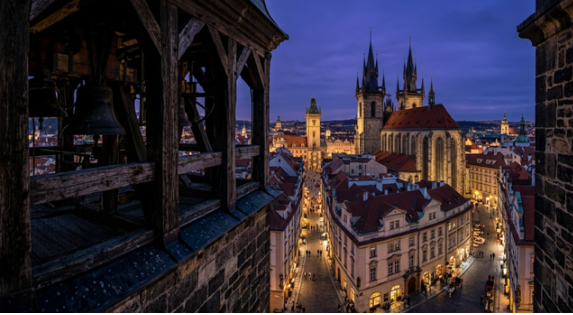
Old Town Square and the Astronomical Clock. At the eastern end of Karlova Street, the medieval lane that funnels foot traffic from the bridge, Old Town Square opens up around the Astronomical Clock, known locally as the Orloj. Mounted on the south wall of the Old Town Hall since 1410, it is one of the oldest astronomical clocks still in operation anywhere. Every hour between 9 a.m. and 11 p.m., wooden figures of the Twelve Apostles parade past two windows above the clock face while a skeletal figure of Death tolls a bell — a mechanical display that has run, with interruptions for war and repair, for over six centuries. Climb the Old Town Hall tower for the view that puts the whole square into perspective, and consider the underground tour included with most tower tickets, which winds through Romanesque foundations older than the buildings standing on top of them today.
The Church of Our Lady before Týn. Behind a row of Old Town Square houses, the twin Gothic spires of the Church of Our Lady before Týn rise nearly 80 metres into the skyline — visible from almost anywhere in the city, yet so closely built into its surroundings that the entrance hides in a narrow alley off the square itself. Construction began in the 14th century and continued for more than a hundred years; the church briefly served as the seat of the Hussite movement before reverting to Catholic control, when its current Baroque interior was added after a fire. Inside, the oldest pipe organ in Prague, built in 1673, still stands, and the astronomer Tycho Brahe is buried near the high altar. For the best photograph of the spires together, step back into Celetná Street rather than craning your neck from directly beneath them.
Prague Castle and St. Vitus Cathedral. Across the river and up the hill, Prague Castle has watched over the city since the 9th century and still holds the record, by most measures, for the largest ancient castle complex in the world. The walk up from the Lesser Town side, past the Baroque palaces lining Nerudóva Street, is itself one of the better short climbs in European travel. Inside the walls, St. Vitus Cathedral dominates — a Gothic cathedral that took nearly six centuries to finish, with construction resuming and stalling across the reigns of kings and the rule of communism before its final stone was set in 1929. Beyond the cathedral, Golden Lane offers a smaller-scale contrast: a row of brightly painted cottages, originally built to house the castle’s sharpshooters, narrow enough that visitors brush both walls walking through. Like discovering a hidden Billionaire Spin among Prague’s lesser-known attractions, these historic corners often leave the strongest impression on visitors. The castle grounds are open and free to enter daily from early morning until 10 p.m.; only the major interiors keep shorter, seasonal hours.
Josefov, the Jewish Quarter. A few minutes north of Old Town Square, the Jewish Quarter, known as Josefov, packs six centuries of history into a few narrow blocks. Jewish communities settled here as early as the 13th century, and despite the devastation of the Holocaust, six historic synagogues, the Jewish Town Hall, and the Old Jewish Cemetery survived largely intact. The Old-New Synagogue, built around 1270, is the oldest active synagogue in Europe and still holds regular services. The Old Jewish Cemetery nearby is one of the most affecting sights in the city: roughly 12,000 visible tombstones, leaning together in tightly stacked layers, mark a burial ground used continuously from 1439 until 1787. Josefov has been a UNESCO World Heritage Site since 1992, and a single combined ticket from the Jewish Museum covers most of the synagogues and the cemetery in one visit.
The Cobblestones In Between. The real character of Old Town lives in the lanes connecting its landmarks rather than the landmarks themselves. Step away from Karlova Street’s souvenir shops into the quieter grid east of the square — Templová, Jilská, Husova — and the crowds thin while the architecture stays just as rich: sgraffito façades, painted house signs from the era before street numbers, and hidden courtyards glimpsed through open doors. A few minutes past the bridge in Lesser Town, the John Lennon Wall adds modern, ever-changing graffiti to all that preserved stone, a reminder that Old Town is still a living neighbourhood, not a museum piece.
Getting There and Getting Around. Václav Havel Airport sits about 18 kilometres from Old Town, and the easiest route in is the Airport Express bus, which runs directly to Hlavní nádraží, Prague’s main train station, in roughly 45 minutes. From there, the Old Town is a short metro ride or a flat 15-minute walk. Once inside the historic core, walking is genuinely the best way to get around: the narrow medieval streets were never built for cars, and the major landmarks are all within a comfortable 20-minute walk of one another.
Where to Eat. Old Town is not short on restaurants, and the better strategy is usually to walk a block or two off the main square, where prices drop and kitchens cook for locals as much as tourists. Classic Czech dishes worth seeking out include svíčková (marinated beef in a creamy root-vegetable sauce with bread dumplings), guláš with dumplings, and roast pork knuckle, almost always paired with a Czech pilsner. For something lighter, look for a smážený sýr (fried cheese sandwich) from a street stand or a slice of medovík (honey cake) in one of the small coffee houses near Týn Church.
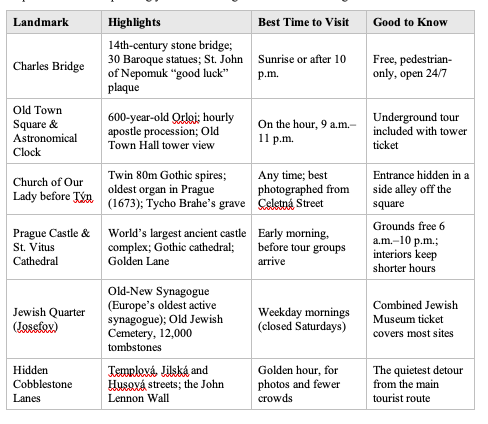
Old Town at a Glance
A quick reference for planning your route through the district’s main sights:
Conclusion
Prague’s Old Town rewards exactly the kind of aimless, curious wandering its narrow lanes were built for. The castles, the bridges and the cobblestones are the headline attractions, but the quieter moments — an empty side street at sunrise, a courtyard glimpsed through an open door, the apostles passing behind the clock face on the hour — are what most visitors end up remembering long after they’ve gone home. Start early, wear shoes built for cobblestones, and leave more time than the map suggests; this is a district meant to be walked slowly, not checked off a list.
