
Québec City's Staircases: A Walk Through the Old Town
Most cities ask you to walk in straight lines. Québec City asks you to climb. Founded on the edge of Cap Diamant, the old town splits into two worlds — the fortified Upper Town perched high on the cliff and the tight commercial lanes of the Lower Town below — and for nearly four centuries the two halves have been stitched together by staircases. Roughly thirty of them thread through the historic core, some grand and photographed a thousand times a day, others tucked between houses where only locals bother to tread. Walk them slowly and you read the city the way it was actually built: vertically, one worn step at a time.
A place like this rewards a certain kind of visitor — the one who plans in two halves. You map a loose morning route through the old town, then leave the evening open for a long dinner, a glass of something local, or a little downtime back at the hotel once your legs have had enough. It's the same easy balance of effort and leisure that platforms likeSpinanzia are built around, a bit of relaxation to offset the day's climbing. Québec suits exactly that unhurried, mix-it-up rhythm. So lace up, and start at the top.
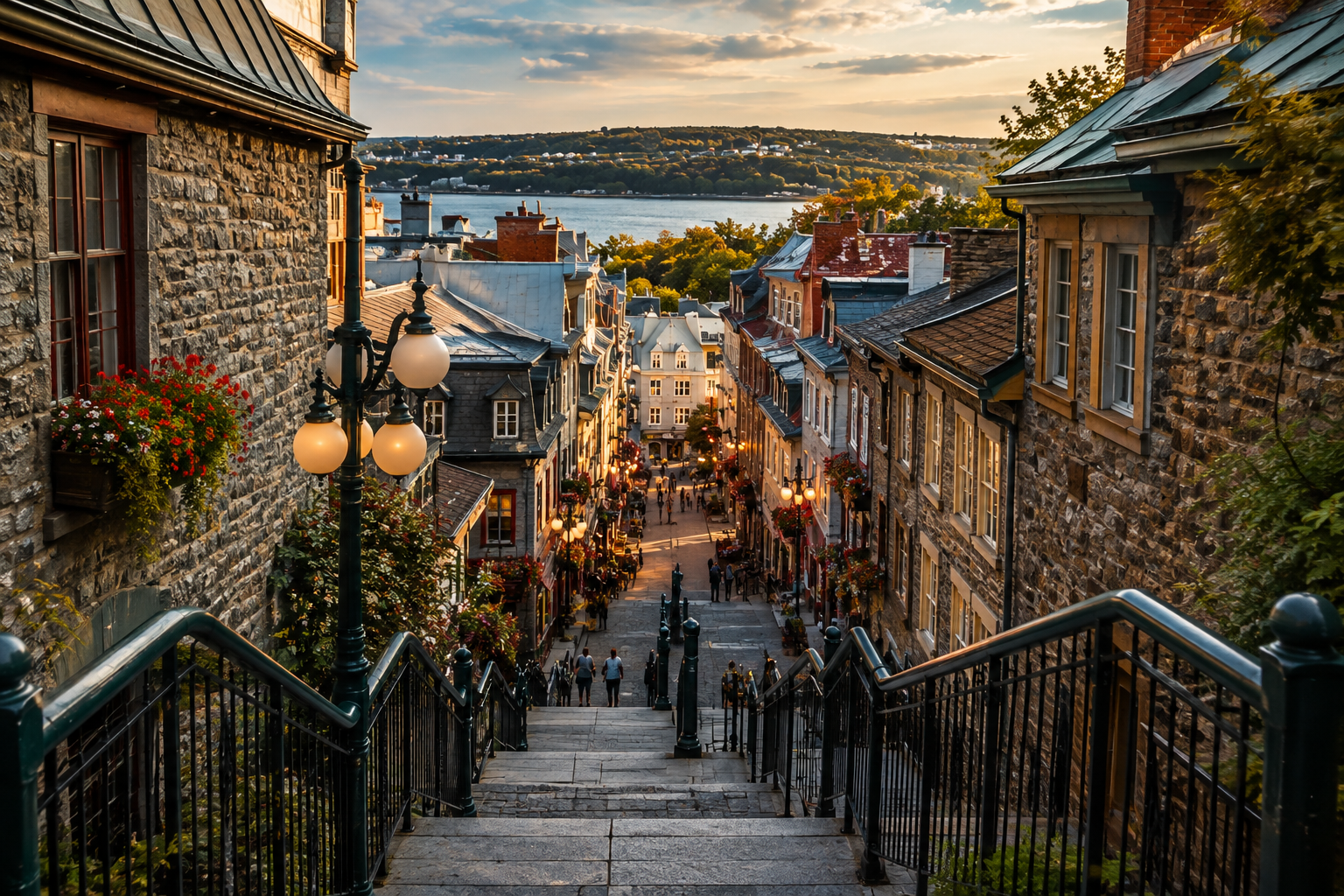
The Breakneck Stairs: where the city tips downhill
Begin where the city began. The Breakneck Stairs (Escalier Casse-Cou) are the oldest stairway in Québec City, laid down in 1635 to connect Côte de la Montagne in the Upper Town with Rue du Petit-Champlain below. There are only fifty-nine steps, but they drop so sharply that 19th-century British tour guides nicknamed them "breakneck," and the name stuck. The wooden originals gave way to a three-flight iron staircase — reworked in 1889 by the celebrated local architect and engineer Charles Baillargé — and then to the version you descend today, rebuilt in the late 1960s.
Pause on the landings. Below you, Rue du Petit-Champlain unspools as one of the oldest commercial streets in North America, its stone facades strung with lights in winter and lined with café terraces in summer. At the foot of the stairs you'll find confectioners, boutiques and the kind of narrow doorways that reward a photographer willing to wait for the light. Right alongside runs the old funicular, gliding up the cliff face since 1879 for anyone who'd rather ride than climb — but you came for the steps.
Down at the birthplace: Place Royale
Let the Breakneck Stairs deliver you to the Lower Town's beating heart. Place Royale is the very spot where Samuel de Champlain planted the first French settlement in 1608, making this cobbled square one of the oldest European sites in North America. Anchoring it is the little stone church of Notre-Dame-des-Victoires, built in 1688 and still holding its ground against four centuries of river winters. Wander the surrounding lanes and you'll see why the staircases matter: everything down here is built at ground level, close and human-scaled, a deliberate contrast to the grand institutional Upper Town you just left. The stairs aren't just a shortcut — they're the seam between two entirely different ideas of a city.
From Dufferin Terrace to the Governor's boardwalk
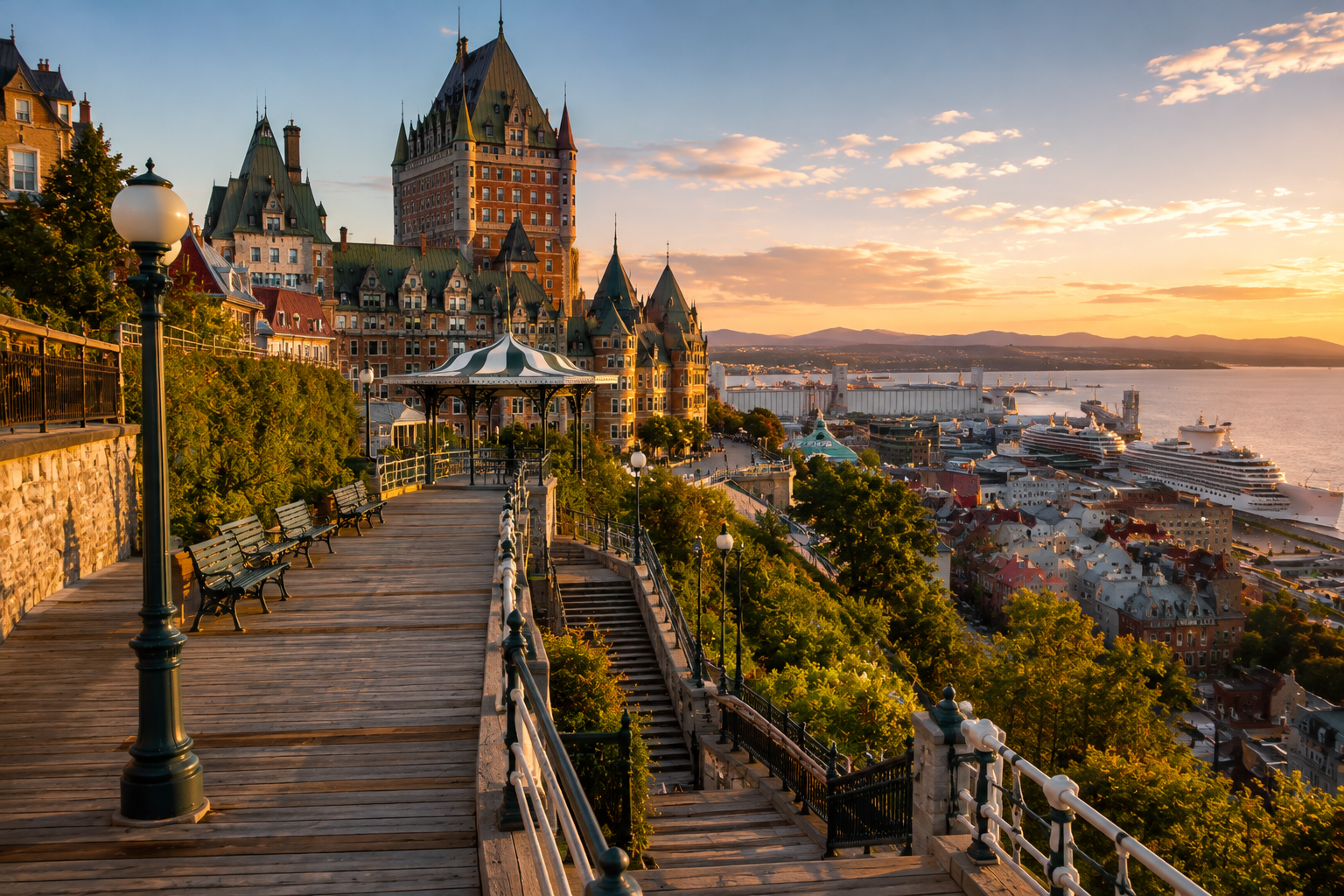
Climb back up and the wide wooden promenade of Terrasse Dufferin sweeps beneath the green-roofed Château Frontenac. Built in 1879 under Lord Dufferin, then Governor General, it remains the finest free viewpoint in the city. Follow it west and it narrows into the Promenade des Gouverneurs, a cliffside boardwalk of some three hundred steps that clings to the rock below the Citadelle. It's a lung-tester in the best way: each flight opens a wider view of the St. Lawrence, until you spill out onto the Plains of Abraham with the river stretching far below. Go at golden hour and the whole climb turns amber, the water catching the last of the light.
The quieter climbs locals actually use
The famous stairs draw the crowds; the everyday ones tell you more. The Escalier du Faubourg — also known as the Sainte-Claire or Le Soleil stairs — is a graceful three-level flight that one local historian judged the city's most soaring, delivering a rooftop view over the Saint-Roch neighbourhood toward the distant Laurentian mountains. For sheer endurance, the Cap-Blanc Stairs are the reigning champion: 398 steps bolted straight into the cliff, the longest staircase in the city and a well-known punishment for runners training their calves.
That competitive streak isn't imagined. Every June, Québec City hosts a Staircase Challenge that links thirty stairways into a single route of more than three thousand steps — proof that here, the stairs aren't just scenery. They're infrastructure with a view, woven so deeply into daily life that residents race up them for sport.
How to walk them well
Wear real shoes; the stone gets slick, and in winter the exposed flights ice over fast. Start high and descend into the Lower Town so gravity does the hard work, then let the funicular or the Breakneck Stairs carry you back up. Move early in the morning or late in the afternoon to dodge the midday crush on Petit-Champlain, and build in rest stops — many of the grander staircases have landings placed exactly where the view deserves a pause. Above all, don't rush. The whole point of a staircase city is that it forces you to slow down, look up, and notice the four-hundred-year-old details most visitors climb straight past.
Québec City won't be hurried. Take the steps.
