
What Expo 67 Left Behind on Montreal's Islands
Image by Lena Marchetti
Over six months in 1967, more than 50 million visitors crossed to two islands in the St. Lawrence River for Expo 67, the world's fair Montreal staged under the theme "Man and His World." Organizers enlarged Île Sainte-Hélène and built Île Notre-Dame beside it, and the fair spread nearly 100 pavilions representing 62 nations across the site. Many of those buildings came down once the fair closed. The ones that stayed now anchor Parc Jean-Drapeau, and together they make a full day's walk a short metro ride from downtown.
Jean-Drapeau station, on the Yellow Line one stop from Berri-UQAM, lets you out at Espace 67 in the middle of the park, and more than 25 kilometres of roads and trails spread out from there. Wooden panels with QR codes mark over 20 points of interest for the park's Voyage des îles web app. The free Portrait Sonore app adds a two-hour audio documentary on the public art, with an original track from a Quebec musician for each of 15 works.
Start at the Dome the United States Left Behind
Buckminster Fuller's geodesic dome served as the United States pavilion in 1967. The U.S. Information Agency commissioned Fuller in 1964, and his frame of steel tubes traces more than three-quarters of a sphere. After the fair, President Lyndon B. Johnson donated the pavilion to Montreal, and the city took possession on January 31, 1968. It hosted exhibitions and gardens until 1976. In 1995 the city gave it a new role as a museum about the environment, keeping only the tubular frame and rebuilding the interior. Since 2021 the Biosphère has belonged to the city's Espace pour la vie network, alongside the Biodôme, the Botanical Garden, the Insectarium and the Planetarium.
Walk the full circle around the dome before going in. The bare lattice frames the sky differently from every side, and it photographs best with the river behind it.
Calder's Discs and the Climb Up the Tour de Lévis
Public art from the fair still dots both islands. Start with Trois disques, the stabile Alexander Calder created in 1967, which reflects the fair's Terre des Hommes theme and was donated by the International Nickel Company.
Next, climb the Tour de Lévis on Mont Boullé. The stone tower went up in 1937, when Île Sainte-Hélène became a municipal park, and it encloses a water reservoir that no longer serves the city. Its walls are breccia quarried on the island itself. The tower reopened after a five-year closure, and 157 steps lead to an observation terrace with a 360-degree view of the islands, the river, the downtown skyline and the hills of the Montérégie. Check the park's schedule before you go, since the tower keeps shorter hours than the grounds.
Gardens, Giant Plant Sculptures and a Racetrack You Can Walk
Cross to Île Notre-Dame and head for the Floralies Gardens, a legacy of the 1980 Floralies internationales de Montréal, a horticultural exhibition with more than 20 participating countries. One of the trees was planted by René Lévesque, then premier of Quebec.
The park is also the permanent home of three works by Mosaïcultures internationales de Montréal, made from about half a million flowers and plants. Mother Earth rises 11 metres and pours a cascade of water from one arm, and The Man Who Planted Trees uses 100,000 plants to honour Frédéric Back's Oscar-winning 1987 animated film. The third, six pairs of YY figures based on the park's Expo 67-era logo, is spread across both islands. The Buvette des Floralies terrace sits a few steps away for a coffee or a seasonal meal.
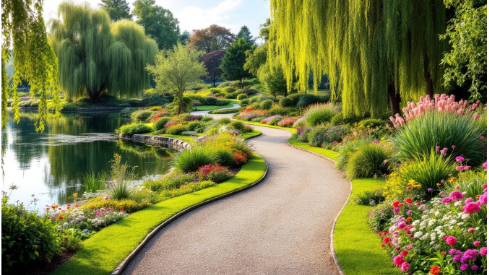
Image by Owen Delacroix
Also on Île Notre-Dame, the old French and Québec pavilions of Expo 67 now house the Casino de Montréal, and LineUps' guide to the best online casinos in canada explains how the online options differ from one province to the next.
Finish the island with a lap of Circuit Gilles-Villeneuve, the 4,361-metre track that has hosted Formula 1's Grand Prix du Canada since 1978. When no event is on, cyclists, runners, inline skaters and walkers share the asphalt, cars are held to 30 km/h, and the views back toward downtown cost nothing.
End at Habitat 67, Across the Water
Moshe Safdie designed Habitat 67 for the fair as housing, a stack of prefabricated concrete units on the Cité du Havre peninsula, across the water from the islands. The City of Montreal and the Quebec government have both classified it as a heritage monument. People still live there, so the way inside is a 90-minute guided tour across its plazas, terraces and footbridges that includes one of the homes. Tickets are sold online only, never at the door, and the 2026 season runs through November on Saturdays and some weekdays.
Cyclists can link the city, the park, Île des Sœurs and the South Shore on the Promenade fluviale du Grand Montréal, a paved route of about 14 kilometres that crosses the St. Lawrence. Back downtown, Everyday Tourist's look at Montreal as an urban playground points to the colour and play built into the city's streets.
Plan the islands for a dry day between late spring and early fall, when the gardens are full, the circuit is open and the summer shuttle buses run from the station. Start early, too: the gardens and most outdoor sites open at 6 a.m., and the Biosphère's lattice looks its sharpest in low morning light.
